

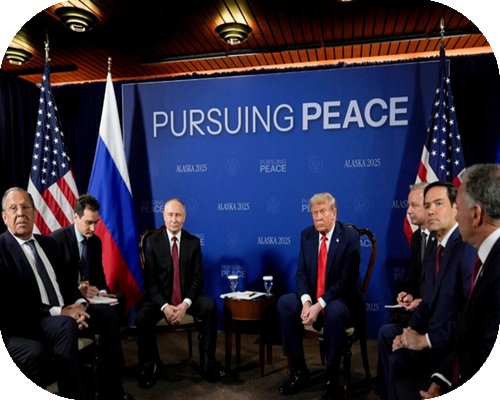
U.S. President Donald Trump’s special envoy Steve Witkoff on Aug. 17 said that Russian President Vladimir Putin agreed at the Aug. 15 Alaska peace summit to allow U.S. and European allies to grant Ukraine security protections similar to NATO’s collective defense mandate as part of an impending deal to end the war.
“We were able to win the following concession: That the United States could offer Article 5-like protection, which is one of the real reasons why Ukraine wants to be in NATO,” Witkoff said on CNN’s “State of the Union.”
The special envoy added that it was the first time the U.S. side “had ever heard the Russians agree to that.”
Speaking at a news conference in Brussels on Aug. 17 with Ukrainian President Volodymyr Zelenskyy, European Commission President Ursula von der Leyen said: “We welcome President Trump’s willingness to contribute to Article 5-like security guarantees for Ukraine. And the ‘coalition of the willing’—including the European Union—is ready to do its share.”
Article 5 of the NATO Charter provides that if an ally is the “victim of an armed attack, each and every other member of the Alliance will consider this act of violence as an armed attack against all members and will take the actions it deems necessary to assist the Ally attacked.”






Witkoff, describing some of the first details from the Aug. 15 summit in Alaska, said the United States and Russia agreed to “robust security guarantees“ that he called ”game changing.”
“We didn’t think that we were anywhere close to agreeing to Article 5 protection from the United States in legislative enshrinement within the Russian Federation not to go after any other territory [in Ukraine],” he said.
While Zelenskyy thanked Washington for its recent signals of offering security guarantees for Ukraine, he said the details are still unclear.
“It is important that America agrees to work with Europe to provide security guarantees for Ukraine,” he said, “But there are no details how it will work, and what America’s role will be, Europe’s role will be and what the EU can do, and this is our main task, we need security to work in practice like Article 5 of NATO, and we consider EU accession to be part of the security guarantees.”
When pressed on why Trump was unsuccessful in pressing Russia to agree to an immediate cease-fire in the more than three-and-a-half-year-long war, Witkoff said the president had pivoted towards securing a peace deal after making so much progress at the Alaska summit.






“We covered almost all the other issues necessary for a peace deal,” he said. “We began to see some moderation in the way they’re thinking about getting to a final peace deal.”
While speaking with ABC’s “This Week,” Secretary of State Marco Rubio emphasized there would be “additional consequences” if a cease-fire or peace agreement is not reached. However, he noted that there would likely not be an agreement on a truce with Ukraine absent from the talks.
“Now, ultimately, if there isn’t a peace agreement, if there isn’t an end of this war, the president’s been clear, there are going to be consequences,” Rubio said. “But we’re trying to avoid that. And the way we’re trying to avoid those consequences is with an even better consequence, which is peace, the end of hostilities.”
Even though it’s not off the table, Rubio said he doesn’t think issuing new sanctions on Russia would compel Putin to accept a cease-fire, adding that the best way to end the conflict is “through a full peace deal.” Rubio also serves as Trump’s national security adviser.
“The minute you issue new sanctions, your ability to get them to the table, our ability to get them to table, will be severely diminished,” Rubio said on NBC’s “Meet the Press.”
However, the secretary of state noted that both sides are “not at the precipice of a peace agreement” and that reaching one would be difficult and take a lot of work.
“We made progress in the sense that we identified potential areas of agreement, but there remains some big areas of disagreement. So we’re still a long ways off,” Rubio said.
Rubio told CNN’s “State of the Union” that Russia and Ukraine won’t be able to get everything they want.


“If one side gets everything they want, that’s not a peace deal. It’s called surrender, and I don’t think this is a war that’s going to end anytime soon on the basis of surrender,” Rubio said.
Speaking with Fox News’s “Sunday Morning Features,” Rubio said that offering Ukraine security guarantees “would be a very big move” by Trump.
“It tells you how badly he wants peace, how much he values peace, that he would be willing to make a concession like that,” he said.
“That’s what we’ll talk about tomorrow.”
Rubio added that administration officials had spoken with national security advisers of multiple European nations on Aug. 16 about security guarantees for Ukraine, with the hope to establish negotiation points that could be presented to Russia during peace agreement talks.
Trump and Putin had focused on several key issues, including drawing borders and military alliances and security guarantees for Ukraine, he said.
“There’s a lot of work that remains,” Rubio said.
Zelenskyy will be joined by European leaders for his Aug. 18 meeting with Trump at the White House, including French President Emmanuel Macron, German Chancellor Friedrich Merz, Italian Prime Minister Giorgia Meloni, Finnish President Alexander Stubb, and NATO Secretary-General Mark Rutte.
Witkoff said he thinks “everybody agreed” that progress was made.
“Maybe not enough for a peace deal, but we are on the path for the first time,” he said.
“The fundamental issue, which is some sort of land swap, which is obviously ultimately in the control of the Ukrainians—that could not have been discussed at this meeting [with Putin]. We intend to discuss it on Monday, hopefully we have some clarity on it, and hopefully that ends up in a peace deal very, very soon.”
Witkoff said the land swap is “one thing that [Trump] cannot agree to on behalf of the Ukrainians” because they’ve asked that of the U.S. side.
“The president is respectful of it, but that’s why we’re moving so quickly to a meeting on Monday,” he said.
The Associated Press contributed to this report.