
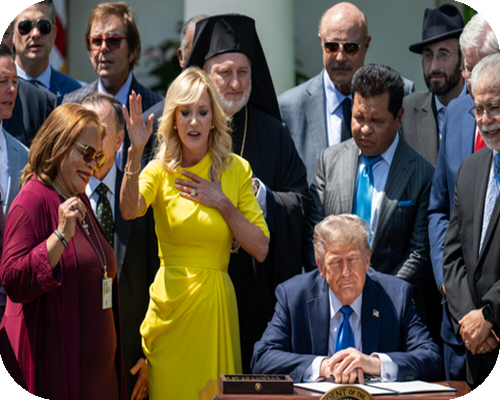
President Donald Trump prepares to sign an executive order alongside religious leaders at a National Day of Prayer event on May 1, 2025, in the White House Rose Garden.
Although the Trump administration recently lifted a 70-year-old ban on political activity by tax-exempt religious groups, some remain cautious and will continue to avoid endorsements and other overt politicking.
Clergy “ought not endorse particular candidates from the pulpit,” the Rt. Rev. Jennifer Reddall, bishop of the Episcopal Diocese of Arizona, wrote after the IRS reversed the long-standing interpretation of law – a stance also taken by some other religious leaders.
While churches should address issues of the day, she wrote in a statement posted on the diocesan website, the pulpit is a “sacred and awe-inspiring place.”
“Preaching the Gospel is often a provocative act – those who heard Jesus preach often walked away self-reflective, perturbed or even angry,” Reddall wrote. “We can identify policies and laws that are consonant with the Gospel … but it is always in service of the Gospel, and not to a particular political philosophy or candidate.”






Congress adopted the ban known as the Johnson Amendment, authored by then-Sen. Lyndon Johnson, in 1954. On July 7 – about six weeks after his swearing-in – new Internal Revenue Service commissioner Billy Long lifted the prohibition. The IRS likened endorsements from the pulpit to a family discussion.
Conservative religious leaders had tried for years to eliminate the Johnson Amendment. President Donald Trump promised to do so during the 2016 campaign. Four months after taking office, he issued a directive ordering the IRS to refrain from enforcing it.
The National Religious Broadcasters and other religious organizations sued the IRS in August 2024 over the law, arguing that it unconstitutionally restricted their free speech rights.
Under President Joe Biden, the Justice Department defended the law. The Trump administration reversed course. In July, the Trump Justice Department submitted a joint motion with the plaintiffs asking a federal judge in Texas to prohibit future enforcement.
“Communications from a house of worship to its congregation in connection with religious services through its usual channels of communication on matters of faith do not run afoul of the Johnson Amendment as properly interpreted,” the motion said.





Like the Episcopal Diocese of Arizona, the U.S. Conference of Catholic Bishops has issued guidance discouraging endorsements.
“The church seeks to help Catholics form their conscience in the Gospel so they might discern which candidates and policies would advance the common good,” the conference said after the Trump administration’s move. “The Catholic Church maintains its stance of not endorsing or opposing political candidates.”
Evangelical Christian groups have welcomed the change.
At the Ethics and Religious Liberty Commission – the public policy arm of the Southern Baptist Convention, policy manager Katy Roberts asserted that “as a matter of law, pastors and other ministry leaders should be free to speak to cultural, social and political issues without fear of the government’s retribution. Southern Baptists, as a group, have consistently defended this right.”
The Rev. David Johnson, executive director of the Arizona Mission Network – the state’s Southern Baptist affiliate – embraced the new policy. He also urged pastors to use the freedom to speak their minds on political topics wisely.
“We can rejoice that it seems the era of fear and intimidation is over no matter what side of the political aisle you might find yourself on any particular issue,” he wrote in a column published by Baptist Press.
But he added, “Before a pastor or church decides to declare once and for all their red or blue colors … it might be wise to consider the impact it might have on their witness. While we should never waffle on important moral and ethical issues, we should pause to consider if the positions we are taking are essential to the Gospel or more an expression of our own political persuasion.”
Johnson, a Texas Democrat serving as the Senate minority leader at the time, proposed the restriction in July 1954. That same month he won a primary against a challenger backed by wealthy Texans who had funneled their support through a pair of tax-exempt organizations. The Senate adopted the amendment to the tax code without debate.


“It was accepted just on its face that 501(c)(3) nonprofit organizations cannot engage in elections – endorsing candidates, speaking on these issues,” said Bob Trent, vice president of communications for the conservative Center for Arizona Policy. “The target was never churches. This was in response to a nonprofit organization advocating against President Johnson in a Senate campaign.”
The Johnson Amendment did not eliminate political activism from the pulpit.
Trump received a slew of endorsements from conservative religious leaders last year, including the Rev. Robert Jeffress, pastor of the 14,000-member First Baptist Dallas, who had long sought to overturn the Johnson Amendment.
Vice President Kamala Harris touted support from over a thousand faith leaders as the Democratic nominee, relying heavily on get out the vote efforts at predominantly Black churches.
Under the new IRS interpretation, the Johnson Amendment no longer covers places of worship but it still applies to other not-for-profit entities.
“The idea that some pastors had felt that they couldn’t (endorse candidates) because the IRS might come after them is exactly why the Johnson Amendment needed to be clarified in that it never actually did apply to churches,” Trent said. “It should never have applied to churches.”
“Every week … no matter the religion, pastors get up and speak about things that go on in their congregation’s lives and elections are part of that,” Trent added. “They should have that decision of what to say from the pulpit … because they are speaking about beliefs, about their faith’s morals and how they should be applied, not inside the walls of the faith ministry but outside, because that’s really what’s intended is how can we carry ourselves out into the public square.”
Candidates for president and other offices routinely speak to voters at houses of worship. Under the Johnson Amendment, the hosts tread carefully.
When Trump stumped at Dream City Church in Phoenix during the 2020 campaign, for instance, the church issued a statement emphasizing that a “facility rental does not constitute endorsement of the opinions of its renters.”
English professor Keith Miller with Arizona State University’s Center for the Study of Religion and Conflict said the policy change could unleash a wave of religious political activism.
“If churches have a tax-exempt status, the thinking was we don’t want them to be just another partisan political outfit,” Miller said. “Even though there are churches that have endorsed candidates, or their clergy have endorsed candidates – and they haven’t been punished – if the Johnson Amendment is thrown out altogether, then it could be there’ll be a whole lot more of that.”
Miller said he’s also concerned that, because churches tend to be politically homogenous, the new rules could add to polarization in society.
“One of the services that those churches provide in addition to their religious mission is to have a place where people can become friends and bond together for a common purpose, and they can have civil discussions about politics,” Miller said.
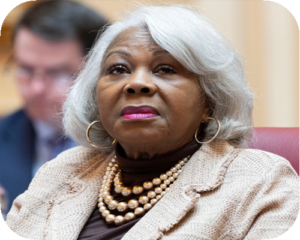
State Rep. Quantá Crews, D-Phoenix, an associate minister at the historic Tanner African Methodist Episcopal Church, called the IRS policy change a “slippery slope.”
Her denomination hasn’t issued any guidance about the change but Crews said she will not endorse any candidates from the pulpit.
“The folks that I’ve spoken to about this are concerned and leery,” she said. “Blurring the lines is really dangerous.
“It’s a delicate balance, and the trust that is given to us as religious leaders is something that should not be taken for granted. If you say that this person is bad for you, people are going to believe you. There’s so much weight to that because they’re expecting you to speak truth every Sunday.”
At ASU’s School of Politics and Global Studies, professor Valerie Hoekstra, who is also affiliated with the Center for the Study of Religion and Conflict, said she expects the change to withstand a court challenge.
The First Amendment prohibits government support for any particular religion but also protects free speech and unhindered religious practice.
“The tricky part of it all is that sometimes the Free Exercise Clause of the First Amendment runs into conflict with the religious Establishment Clause,” Hoekstra said. “They just make it difficult to balance that interest.”