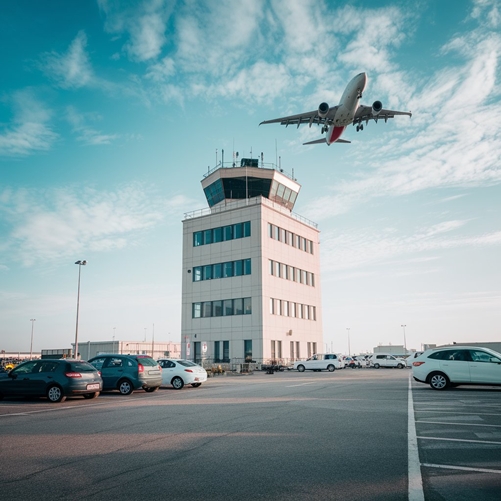
Airlines for America (A4A), a trade association of leading U.S. airlines, commended President Donald Trump for signing into law the One Big Beautiful Bill Act that contains a $12.5 billion provision to modernize the country’s air traffic control (ATC) systems, the group said in a July 4 statement.
The bill, signed by Trump on Independence Day, sets aside roughly $12.5 billion for “acquisition, construction, sustainment, and improvement of facilities and equipment necessary to improve or maintain aviation safety.”
The amount will be appropriated to the administrator of the Federal Aviation Administration and remain available until Sept. 30, 2029.
The biggest share of these funds, $4.75 billion, goes to modernizing telecommunications infrastructure and upgrading relevant systems; $3 billion for radar systems replacement; $1.9 billion for constructing a new air route traffic control center; and $1 billion for terminal radar approach control facilities.
The law allocates $500 million for purposes such as runway safety technologies, airport surface surveillance technologies, and runway lighting systems.






Funds will also be used for acquiring and installing automated weather observing systems and air traffic controller advanced training technologies.
“Promises made, promises kept. President Trump pledged to the American people he would address our country’s aging air traffic control (ATC) infrastructure. Today, he followed through on his promise by signing $12.5 billion of ATC investment into law,” said A4A President Nicholas E. Calio.
“This initial funding will allow Transportation Secretary Sean Duffy to begin implementing the administration’s plan to overhaul the system with new, modern technology that will make air travel safer and more efficient,” Calio said.
Calio said Trump and Duffy acted quickly to address the modernization of America’s complex ATC system, highlighting that only a few people have had the “gumption” to take on this vast undertaking.
U.S. carriers transport 2.7 million passengers and 61,000 tons of cargo per day, making updates in American airspace “long overdue,” he added.






Outdated Systems, Worker Shortages
In a May 21 letter, the CEOs of 10 airlines wrote to members of Congress, warning that the country’s ATC was “failing” American citizens.
Currently, technology and equipment from the 1980s are being used in the U.S. ATC systems, with 92 percent of the FAA’s Facilities and Equipment budget going into maintaining these “outdated systems,” the letter said.
America’s air traffic controllers should not be operating with “corroded copper wiring, floppy disks, and physical strips of paper with flight numbers,” said the CEOs.
The letter also cited a 2023 FAA report, which warned that understaffing at the Air Traffic Organization—an FAA arm responsible for providing safe and efficient air navigation services—was eroding the ATC system’s margin of safety.
“This is unacceptable. U.S. airlines, our pilots, flight attendants, technicians, and ground employees will never compromise on safety. Congress must do the same,” said the letter.
There have been multiple safety-related incidents at airports over the past few months due to equipment issues.
In May, air traffic controllers in Denver were forced to switch to emergency backup frequencies after they lost contact with aircraft for around 90 seconds. The controllers had to use emergency backup since both primary and main backup frequencies went down.
Another incident took place in late April when controllers overseeing the Newark Liberty International Airport lost contact with planes for about 30 seconds, leading to flight delays.


The Trump administration is taking steps to tackle the issue of air traffic controller shortages.
On July 2, Duffy announced that the FAA signed an agreement with Middle Georgia State University to make the institution the next school for the Enhanced Air Traffic-Collegiate Training Initiative (AT-CTI).
“Enhanced AT-CTI programs like the one at Middle Georgia State University are key to building a next-generation workforce, reducing delays, unlocking the future of aviation,” Duffy said.
“We need more of the best and brightest in our towers to make our nation’s air traffic system the envy of the world.” The FAA estimates there is a shortage of roughly 3,000 air traffic controllers nationwide.