



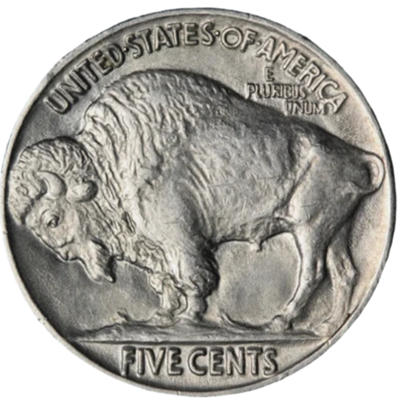
For 25 years, a living symbol of the Old West graced a popular U.S. coin. In the early 20th century, the one-cent and five-cent pieces were the workhorses of American coinage. From the popular nickelodeon to public telephone calls and coin-operated vending machines, nickels were widely circulated. And during its 1913 to 1938 run, one variety featured a shaggy beast.
The coins first entered circulation when they were handed out to President William Howard Taft, Native American chiefs, and other dignitaries attending the groundbreaking ceremony for a National American Indian Memorial on Staten Island, N.Y. (it was never built) And from that first day, the new five-cent piece drew mixed reviews.
A popular magazine for coin collectors opined the Indian’s head was too big and urged the American bison on the reverse be scrapped entirely.
Yet something about that big behemoth clicked with the American public, which quickly “coined” the phrase the Buffalo Nickel.
And the real-life animal that may—or may not—have been used as a model for its likeness wasn’t just any old run-of-the-mill buffalo, either. Unlike the romanticized lyrics of “Home on the Range,” this bison had never roamed the Great Plains or anywhere else out West.




Sculptor James Earle Fraser found the perfect specimen in 1911, not where the deer and antelope play, but at the Bronx Zoo.
The animal’s name was Black Diamond and he was indeed a beast. Born to a female bison in the famous Barnum & Bailey Circus in 1893, he was donated to a zoo where he grew to a stout 1,550 pounds. He was a favorite of visitors for many years, and Fraser claimed he captured the sculpture’s imagination.
Fraser called Black Diamond “the contrariest animal in the Bronx Zoo. I stood for hours … He refused point blank to permit me to get side views of him, and stubbornly showed his front face most of the time.”
There’s just one problem. Fraser specifically said he found the animal at the Bronx Zoo. But Black Diamond was never there; he spent his days in the Central Park Zoo.
Regardless of whether he provided the famous profile, he met a sad end.






Two years after the new nickel’s debut, Black Diamond was aged and ailing. Now 22 and experiencing difficulty moving around, zoo officials put him up for auction on June 28, 1915. There were no bids.
So he was eventually sold for $300 (about $10,000) to a game and poultry dealer. That unleashed a public outcry, with some people even offering $1,000 to save the beloved bison. But it was too late. A deal is a deal, after all, and Black Diamond was led to the slaughterhouse on November 17. The 750 pounds of meat was sold for $2 a pound, almost $67 in 2026 dollars. His warm fur was turned into a 13-foot automobile robe, a trendy accessory at the time.
A taxidermist mounted the head, which has shown up at major coin shows from time to time, billed as the Buffalo Nickel’s inspiration.
As late as 1952, the associate curator of mammals at the prestigious American Museum of Natural History wrote in Natural History magazine, “(Black Diamond) was an excellent object for the artistic brush. … Despite his size, he was quite docile. This virtue made him the perfect model.”
Yet academics view Black Diamond’s claim to coinage fame with skepticism. In fact, the Bureau of the Mint doubts Fraser used any live models at all, since he was a noted authority on Western art.
Incidentally, some folks also claim Black Diamond was used for the drawing of an American buffalo appearing on the 1901 $10 U.S. Banknote.
For a generation of American children, the buffalo nickel meant a candy bar or a soft drink. For the animal who may have inspired it, fame offered no such sweet reward. Black Diamond ended up on the butcher’s block.



J. Mark Powell | INSIDE SOURCES
Recent Articles
City of Prescott Announces Thanksgiving Holiday Closures and Solid Waste Collection Schedule Changes
Hotel St. Michael Heralds in the Holidays with 125-Year Anniversary
Pine Ridge Marketplace Announces Third Annual Tree Lighting and Holiday Events: Kickoff on November 24
Choirs, musicians, dancers to perform at annual ‘Celebration of Thanks’ in Prescott