




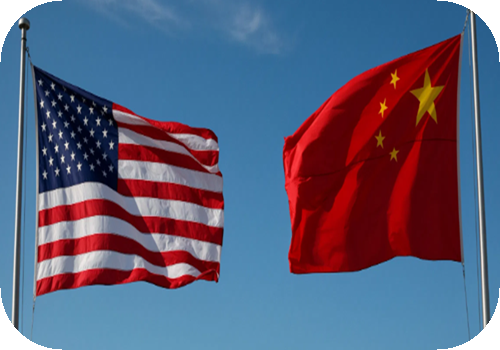
A group of 12 former military officials and national security experts is urging President Donald Trump to protect the nation’s food supply by giving American fertilizer makers priority access to domestic sulfur, warning that Chinese trade practices are driving up farm costs and threatening household grocery budgets.
In a Nov. 20 letter to Trump and members of his Cabinet, the group, led by retired Army Maj. Gen. James “Spider” Marks, asked the administration to consider invoking the Defense Production Act. That Cold War-era law allows the president to require businesses to prioritize orders from U.S. companies deemed essential to national defense.
“I see an adversary’s playbook: China cut its fertilizer exports to almost nothing and restricted sulfuric acid exports,” said retired Air Force Col. Rob Maness, who signed the letter. “The effects of China’s actions have squeezed American grocery bills. Sulfur is a critical input for fertilizer and munitions, so our letter asked for a supply chain security strategy, with the DPA as one important option to consider.”
The appeal comes as prices for two widely used phosphate fertilizers near $1,000 a ton. Refineries extract sulfur as a byproduct of oil and natural gas processing, and fertilizer manufacturers convert that sulfur into sulfuric acid to unlock nutrients from phosphate rock.
According to the Marks-led open letter, state-backed Chinese companies are outbidding American buyers for sulfur while Beijing restricts exports of the finished phosphate fertilizer its factories produce. That combination leaves farmers worldwide competing for tighter supplies, the authors wrote, comparing Beijing’s leverage over fertilizer to its dominance over rare earth magnets critical to many modern technologies.





“Making life unaffordable is a way to inflict pain on the United States,” Marks, a former senior Army intelligence officer, said in a statement.
Retired Air Force Lt. Gen. David Julazadeh, who held several NATO posts, said he signed the letter because the country needs reliable domestic production and trusted allies to keep Americans fed if global trade is disrupted by disputes or armed conflict.
“Don’t wait for the crisis to figure it out,” Julazadeh said in an email. “You need the relationships, contracts, transportation, infrastructure, and authorities worked out beforehand. For me, this is less about fertilizer specifically and more about making our critical supply chains resilient before we actually need them.”
Trade data shows that global supply pressures extend beyond direct Chinese purchases from the United States.
The U.S. recovered 7.5 million metric tons of sulfur in 2025 and exported 1.75 million metric tons, or about 23%, according to the U.S. Geological Survey. More than half of those exports went to Brazil and Mexico, while just 44 metric tons shipped directly to mainland China, according to World Bank data — though trade analysts note that it is unclear how much U.S. sulfur reaches Chinese buyers through third-party intermediaries.


Meanwhile, the U.S.-Iran conflict has reduced fertilizer and sulfur shipments from Persian Gulf producers through the Strait of Hormuz. China’s own imports of elemental sulfur plunged 58% in the first half of 2026 compared with a year earlier, curbing its domestic fertilizer output, according to the International Food Policy Research Institute. Chinese traders recently told S&P Global that local producers are holding back exports to supply domestic farmers ahead of winter stockpiling, with no timeline for resuming shipments abroad.
Former Rep. Chris Carney, another signatory of the Marks-led letter, said the Gulf crisis has further complicated logistical issues.
“Because of the war, there is a shortage of vessels that are available to ship the fertilizer,” Carney said. “The same holds for trucking. I was told there’s a shortage of trucks to deliver the fertilizer once it’s available.”
Those global bottlenecks are already hitting American producers and growers.
In the second week of November, fertilizer retailers surveyed by agricultural news service DTN quoted an average price of $947 a ton for diammonium phosphate, up 2% from a year earlier, and $995 a ton for monoammonium phosphate, up 7%.
How quickly higher fertilizer bills translate into higher prices at the supermarket checkout line is harder to measure. Farms received an average of 12.6 cents of every dollar Americans spent on domestically produced food in 2025, including restaurant meals, according to the Agriculture Department. Fertilizer is just one expense farmers must cover from that share. At the same time, most consumer food spending pays for processing, packaging, transportation, and grocery store labor after crops leave the farm.
To ease pressure on growers, Trump authorized the Commerce Department in June to suspend duties on phosphate fertilizer imported from Morocco, a move the National Corn Growers Association praised as farmers face rising costs on several fronts, including fuel costs.
However, imports of phosphate fertilizer have been paltry at best from Morocco since the suspension of the countervailing duties. The Moroccan state-owned fertilizer company, OCP, promised 2 million tons of fertilizer, but it has delivered just under half of that volume to date. Much of what has arrived is triple superphosphate, a lower-quality product than the monoammonium phosphate and diammonium phosphate that American farmers typically use. The main proponent of lifting the duties, Deputy Agriculture Secretary Stephen Vaden, presided over the Moroccan company’s challenge to U.S. trade duties and ruled in its favor in his prior role as Court of International Trade judge.


In the meantime, some farmers are adjusting to the shortages. In Piatt County, Illinois, farmer Eric Miller told a University of Illinois Extension audience in October that he relies on soil testing to decide which acres can skip fertilizer applications. On fields that already have ample phosphorus reserves, he said, he can hold off for two or three years without hurting crop yields.
“So we try to build when those products are cheap, and we try to cut back or not apply when those products are expensive,” Miller said.
The Chinese government is holding back fertilizer exports to supply its own farmers. National security experts are pleading with Washington to act with the same urgency by securing access to domestic sulfur for U.S. producers. Farmers like Miller can stretch what they already have, but only for so long.



Randall Bloomquist | INSIDE SOURCES
Recent Articles
City of Prescott Announces Thanksgiving Holiday Closures and Solid Waste Collection Schedule Changes
Hotel St. Michael Heralds in the Holidays with 125-Year Anniversary
Pine Ridge Marketplace Announces Third Annual Tree Lighting and Holiday Events: Kickoff on November 24
Choirs, musicians, dancers to perform at annual ‘Celebration of Thanks’ in Prescott