




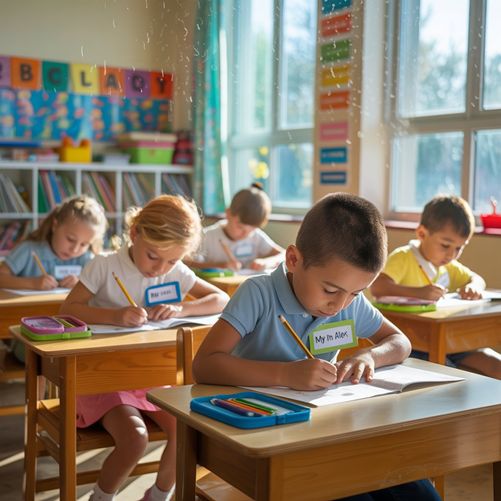
Walk into many classrooms in this new school year, and you will notice something: empty desks. Not a few. Not temporarily. Fewer students are enrolling in public schools. Since the pandemic, enrollment has dropped by 1.4 million students, and analysts expect it to keep falling through 2031.
Public-school enrollment stood at 50.8 million students in fall 2019. By fall 2024, it had fallen to 49.4 million, a decline of 1.4 million students, or 2.8 percent, according to the National Center for Education Statistics.
This is not merely the fallout of the COVID-era disruption. It’s a structural shift that will affect real decisions.
Higher education has confronted this problem before. At the University of Missouri, after enrollment plunged following highly publicized campus turmoil in 2015, alongside demographic and competitive pressures, the university projected an additional 7.4 percent decline in 2017. Rather than maintain a university for students no longer there, administrators eliminated 400 positions, mostly through attrition and vacancies, and reviewed academic programs for consolidation or elimination.
None of those decisions were painless. Neither was pretending this problem would solve itself.


Public K–12 districts now face their version of this challenge.
Districts cannot shrink overnight. Buildings still need heat. Buses still have routes. A classroom may need a teacher whether it contains 22 students or 19. Salaries and employee benefits account for nearly 80 percent of public schools’ current expenditures. Those realities limit flexibility, but they do not make school budgets fixed.
Georgetown University’s Edunomics Lab has spent years showing education leaders that budget reductions do not have to mean across-the-board cuts. Leaders have options short of layoffs. They can leave positions unfilled as enrollment drops. They can reassign staff to be where the students are. They can consolidate programs that aren’t working well or eliminate spending that’s no longer producing enough value for students.
A new peer-reviewed study examined every U.S. public school district from 1998 to 2019. The researchers found something interesting: when districts lose students, they generally end up with more money per remaining student than growing districts.
That does not mean enrollment loss is painless. It means leaders often have some financial runway to plan rather than simply react. They should use it.



A tighter budget is an opportunity to revisit programs that have accumulated over the years and ask a basic question: Is this spending still helping students? Low-impact programs should not become permanent because eliminating them is politically difficult. Temporary revenue should not be used to create permanent obligations.
Enrollment can decline for many reasons, including demographics, migration, charter schools, homeschooling and private school choice. Critics often portray enrollment losses tied to education savings accounts or school voucher programs as uniquely destabilizing for districts. The budgeting challenge is fundamentally the same regardless of why students leave. The important question is whether funding systems give schools enough time to adjust, and whether leaders use that time wisely.
Sometimes that will require painful decisions, including staff reductions or school closures. Pretending otherwise would not serve school leaders or students well. However, the first obligation of a public education system is not to preserve every job, building or program. It is to use the resources available to provide the best education possible for the students who show up.
Fewer students should not automatically mean worse schools. Done thoughtfully, right-sizing can mean smaller, stronger ones.




Martin Lueken | INSIDE SOURCES
Recent Articles
City of Prescott Invites Community Members to Learn More About Long-Term Water Management Plan
October Gardening Classes Every Saturday at Watters Garden Center
City of Prescott to Host Public Meeting on Willow Lake Management Plan
Prescott Fine Art Launches Monthly Art Auctions at Pine Ridge Marketplace