

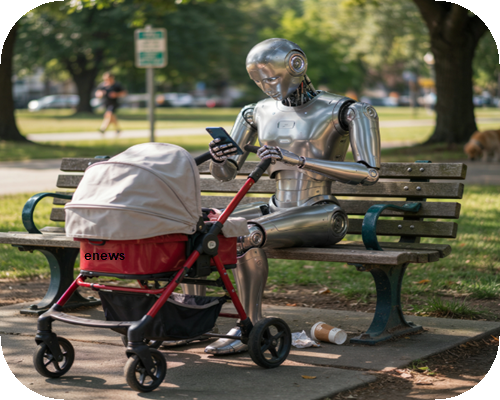
As I scrolled social media recently, I saw a meme that just stopped me. The graphic showed a robot changing a diaper as a mom lounged in a chair wearing headphones.
I immediately felt a deep tension between the unsettling image and the self-awareness that, as a man, I may not be the right voice in this discussion. I also wrestled with the idea that this might be tomorrow’s problem and that I should keep scrolling.
As time passed, the provocative image kept surfacing in my mind. A domestic robot replacing the caregiving tasks of a parent. Eventually, I had to ask: Is this really “tomorrow’s problem”?
Domestic robots are already part of many homes. I have a robotic vacuum that I use often, but to be clear, we are talking about humanoid robots. In this futuristic scene, a humanoid robot would not simply be a taskmaster like my vacuum cleaner. It would be powered by the most advanced AI capabilities available, and it would most likely be updated as technology improved.
Imagine all the capabilities that you find in your favorite AI model, provided in your home by a humanoid robot.




AI has already been widely adopted to help with parenting tasks. A 2026 survey of more than 1,000 parents by Lurie Children’s Hospital reported that 81 percent were using AI to help them. Those uses included: Meal prep, help with homework, and even behavior advice. On the surface, AI has replaced only advice from grandparents, Google searches, online blogs and parenting books.
As a pastor, I see great benefit in generational or community support for parenting, and I would never gloss over those replacements as unimportant. That discernment is supported by a 2026 report by the Institute of Family Studies. In a survey of 24,000 parents, those with more community support often report a more positive parent experience.
That is not the only lost benefit. Parents who have adopted AI also report concerns about their children’s use of artificial intelligence. In the same survey, three out of four respondents are concerned about the rise of AI use among children. The top concerns noted were a decline in critical thinking, exposure to misinformation and the replacement of human interaction.
Another concern for parents, specifically moms, is the impossible quest for perfection. My wife shared the challenges of “mom guilt” with me. A recent Telefora survey reported that 91 percent of mothers experience “mom guilt,” and three in four moms say they sometimes worry they are not doing enough for their kids. Simply put, moms put extraordinary pressure on themselves not just to provide for their kids, but to give their children the very best.
AI’s promise in the home seems to fit the unrealistic pressure to provide the best possible childhood like a puzzle piece.


The Lurie Children’s survey reported that two out of three parents noted that AI has reduced their mental load, and 91 percent said it makes them feel more confident as parents.
The decrease in mental load is a gift, and coupling that with increased confidence? Most would not see a problem. The challenge for parents as they navigate the future is just how much they rely on AI.
Looking at where we stand today, it is easy to see a future in which parents rely on AI to plan every meal, provide tutoring for their kids, manage the family calendar, and monitor their children’s health. Will it end there?
Artificial intelligence can’t do physical tasks like changing a diaper or bathing children, but we are likely closer to that future than we realize. And when it happens, parents will have to weigh the risks of delegating caregiving tasks to machines.
Can AI replace moms? No, but not because AI will lack the capability of replacing many roles that moms, or parents in general, fulfill.
As moms strive for perfection and turn to AI for the absolute best plan for their children, they might miss something important.
Children are not looking for their needs to be met in a transaction. At their very core, children desire to feel loved and valued. They are not bothered by imperfections, and long for a mother’s authenticity and nurturing nature. They want exactly what makes their specific mom a mom.
AI will continue to affect how parents raise their children, and as the capabilities grow, more and more parents will leverage the technology’s incredible power to help them make parenting decisions, but AI cannot replace the best parts of parenting.


AI cannot pray over your children. AI cannot model reading the Bible to your children. AI cannot provide a warm embrace after a disappointment. AI will not remind your children to wash behind their ears, and it will not wait up anxiously to hear how the date went.
Children are not looking for perfection; they are looking for mom.