


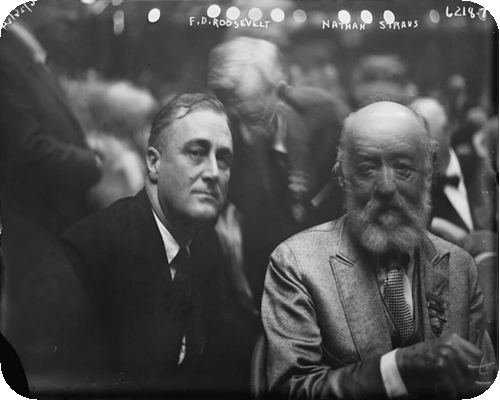
Nathan Straus with Franklin D. Roosevelt at the 1924 Democratic National Convention. (Wikipedia)
Life was a struggle for Nathan Straus from the very start. In 1854, his Jewish family immigrated from Germany when he was six. Told that business opportunities were good in the South, they settled here. The small store and trading company they established did well until the tragedy that was the Civil War wiped it out. Convinced it would be decades before the South recovered, the family moved yet again. This time to New York.
L. Straus & Sons followed, quickly becoming a leading importer and wholesaler of glassware and crockery. At long last, fortune was finally smiling on the Straus family. Nathan married in 1875 and soon had six children of his own.
Straus and his brother Isidor soon sensed a fresh opportunity. They were intrigued by a new type of store pioneered by Rowland H. Macy and others. They grew increasingly involved with the Macy’s business and, in 1888, became partners in the department store. By 1896, they were co-owners.
Growing public interest in department store shopping led Nathan and his brother to buy a dry goods store of their own in Brooklyn, which turned into Abraham & Straus. It eventually became one of New York’s major department stores.





Straus was growing very rich. Yet that wealth didn’t spare him from personal tragedy.
Of the six children born to Nathan and Lina Straus, three died young. Child mortality may have been more common than today, but it was no less painful. And one daughter’s loss in particular cut especially deep.
In 1878, while on a European trip, toddler Sara died suddenly on board a ship. Her parents believed that most innocent of all substances—milk—was to blame. They suspected it was contaminated. Milk wasn’t purified as it is today. Yet hope was on the horizon.
Louis Pasteur had demonstrated how slightly heating liquids kills disease-causing microorganisms. The process was later adapted to milk to combat tuberculosis, diphtheria, typhoid and scarlet fever, along with dangerous bacteria such as Salmonella and E. coli that can secretly lurk within without damaging taste.
Straus’ suspicions later intensified when the problem hit home yet again. Back then, wealthy families often owned a milk cow to supply their dairy needs. One day Straus’ cow, which had appeared healthy up until then, suddenly became sick and died. An autopsy confirmed the cow was carrying tuberculosis.






That cemented the deal for Straus. Spurred by memories of little Sara’s loss, he began exploring the new pasteurization process for milk. In 1892, the Nathan Straus Pasteurized Milk Laboratory was opened. He eventually established 17 supply centers around the New York metro area to ensure it reached kids. His mission expanded when he was appointed president of New York City’s Board of Health in 1898. He even promoted his message through a book, “Disease in Milk: The Remedy, Pasteurization: The Life Work of Nathan Straus.”
And he paid for much of it out of his own pocket.
The result? One historical record shows that 20,111 babies were fed pasteurized milk from Straus’ centers; only six died. Another indicates that in 1897, the infant mortality rate on Randall’s Island was 44%. When pasteurization began the next year, it was cut to 20%. By 1904, it had fallen to about 16.5%.
Straus did not spend substantial amounts of his money and time to impress people. His commitment and involvement began before the modern federal income tax and charitable deduction existed, so those tax benefits could not have motivated his campaign. There were no such things as image consultants then, so he didn’t do it to enhance his PR profile.
He did simply because he wanted to help as many moms and dads avoid the heartache he’d experienced when Sara died.
Straus’ generosity wasn’t limited to safe milk for children. He opened homeless shelters during the economically devastating Panic of 1893 (when he also had his milk station sell coal at affordable prices so the poor could heat their homes in winter). He gave large amounts to the New York Public Library, supporting programs that encouraged young readers. He even sold penny meals during another economic downturn in 1914-15, serving 1,135,731 of them to folks who otherwise would have gone hungry.
Nathan Straus was a very rich and very beloved man when he passed away in January 1931 at age 82. And somewhere, little Sara was probably proud of all her papa had done to protect so many other little ones just like her.