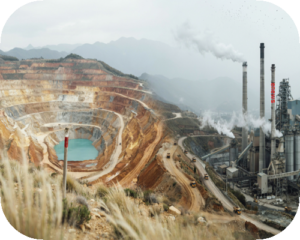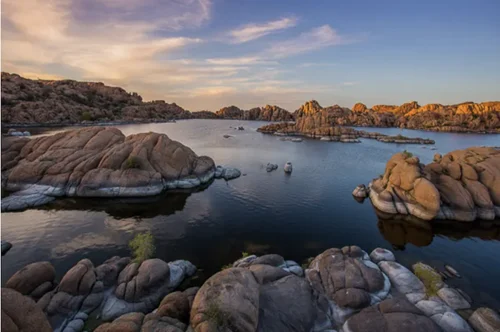
Water is everywhere. Yet we haven’t perfected how to manage its distribution or reliability.
Indiana is living that reality right now. The White River is flooding. People have died. More than a thousand people are displaced from their homes. Despite the best planning and infrastructure, water has a way of ignoring the boundaries people create. What happens upstream can affect communities and ecosystems downstream.
Conversely, Lake Powell and Lake Mead, the two largest reservoirs supplying the southwestern United States, reached historically low water levels this past week. Water is not everywhere in the West.
The paradox of water surplus versus scarcity is fundamentally an economic issue. Water’s value is inverted. We treat it as free when it’s abundant, but when it’s scarce, it becomes precious. Currently, our infrastructure, agriculture and investment decisions are built on the assumption of a predictable water supply, but this assumption is collapsing. As water scarcity increases, its value spikes, but only for those positioned to capture it. Already, communities and industries caught off-guard are facing cascading costs such as higher food prices, stranded or outdated infrastructure, and regional economic disruption.
Forecasts of a Super El Niño offer some hope for California and its neighbors. More precipitation could mean greater snowpack in the Sierras, but only if the expected storms produce snow rather than rain and the snow melts at a manageable pace. If the snowpack builds and melts slowly, that water can help replenish depleted groundwater. If it melts too quickly, much of the benefit can be lost to runoff and flooding.






Facing growing water constraints, some regions are turning to technology. Desalination is expanding across coastal regions, and Israel has demonstrated its potential by sourcing 75 percent of its drinking water from the sea. More recently, the Claude “Bud” Lewis Carlsbad Desalination Plant has contributed to a regional water surplus, helping transform San Diego County from a water importer into a water exporter.
Yet desalination is not without challenges. Modern intake, outfall and diffuser designs, combined with strict environmental standards, have significantly reduced impacts on marine ecosystems. Long-term success also depends on operational excellence, proactive maintenance, and continuous performance optimization to ensure reliable, efficient, sustainable water production.
The same trade-offs are intensifying as different industries compete for water. Agriculture is by far the largest user of freshwater in the United States and globally. Populations require food, and growing food requires water. Agriculture is often cited as the culprit behind water scarcity, particularly in drought-stricken California. Yet California’s Central Valley produces one-fourth of the United States’ food, including 40 percent of the country’s fruits, nuts and vegetables. About 80 percent to 90 percent of the nation’s winter vegetables are grown in California’s Imperial Valley.
The economic stakes are staggering. Losing that productivity would ripple through national food supply chains and consumer prices. A sustained drought that curtails California’s agricultural production will significantly reshape grocery costs, regional employment and export competitiveness. Due to climate and soil limitations, other American agricultural regions cannot easily absorb that volume. Sustainable food productivity in California is an agricultural issue … and a national security issue too.
Data centers, which support the rapid expansion of artificial intelligence, account for a much smaller share of national water withdrawals yet continue to receive much attention related to their water consumption. However, their relative water consumption to other uses is nominal. Most now operate on closed-loop systems and reuse the same non-potable water without drawing fresh water from the communities in which they are built. Data centers make great headlines but are hardly the culprits of water scarcity.





Each region’s water solution will be different. In some places, the answer may be more storage. In others, it may be conservation, groundwater recharge, desalination, or better forecasting about how much water is available and where it is going. Forecasting and technology alone are insufficient.
Ultimately, governmental regulations will determine the boundaries for action. Unfortunately, regulations also determine the winners and losers in water allocation. The West is reckoning with this now. The Bureau of Reclamation’s recent intervention in the Colorado River Crisis signals that crisis-driven regulation is no longer adequate. Proactive policy that prices water fairly, protects productive capacity and builds redundancy into supply chains must replace the old assumption of abundance. The longer we delay, the steeper the cost.
The opportunity begins with recognizing that we live on a wet planet and still can’t count on the water. That unreliability is now an economic asset we must learn to value, protect and allocate wisely.