



Seats in the House of Representatives and the Senate will be at stake this fall as both parties vie for control of Congress.
As the political jockeying continues, one issue will be a priority for millions of voters, even though it won’t appear on a single ballot: affordability.
It was less than two years ago that President Trump was swept back into the White House and gave Republicans control of Congress. Now, two years later, the midterm elections will serve as a referendum on the policies the administration has advanced since January 2025.
The good news for Republicans is that Trump has compiled an impressive list of accomplishments — from securing the border and restoring American energy dominance to rebuilding military strength and pursuing fairness with America’s trading partners.
Yet for many voters, none of those achievements will matter as much as the prices they pay at the grocery store.





To the president’s credit, he has demonstrated that an America First trade policy does not require inflexible tariffs in every circumstance. His administration has shown a willingness to make targeted adjustments to tariffs when doing so benefits American consumers.
The executive order eliminating tariffs on “unavailable natural resources” — products that cannot be produced domestically at commercial scale, including coffee, bananas and many spices — is an excellent example. The administration has similarly provided targeted relief for certain consumer electronics, automobiles and auto parts. Those decisions recognize an important principle: When tariffs no longer advance their intended purpose, the administration should revisit them.
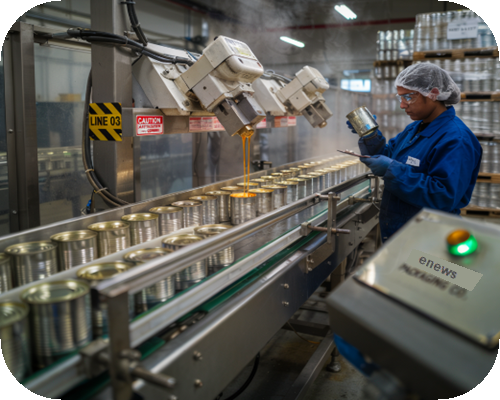
One area ripe for that same pragmatic approach is steel tariffs, specifically those applied to tinplate steel used to manufacture American-made food cans.
Unlike many steel products, tinplate is no longer produced in sufficient quantities in the United States. Domestic production has steadily declined over the past decade, with the number of operating tinplate production lines falling from 12 in 2018 to just three today. Even after U.S. Steel’s planned restart of production in Gary, Ind., American manufacturers will still depend significantly on imported tinplate to satisfy domestic demand.
That makes the current tariff policy difficult to justify. As one Michigan State University economist recently observed in an enlightening long-form Bloomberg story on this topic, the tariffs are intended to protect production of a material that U.S. steel companies largely no longer want to produce.






Bloomberg also reported that uncertainty surrounding trade policy has complicated efforts to find a buyer for the former Weirton, W.Va., tinplate mill after Cleveland-Cliffs shut it down in 2024.
The economic consequences are straightforward, including for the U.S. canned food industry and for the families who depend on these pantry staples.
Bloomberg’s report highlighted that canned foods have experienced larger price increases than many other grocery categories since the tariffs took effect. Campbell’s, for example, noted that while it does not control retail pricing, it has been working to keep its products affordable for consumers, despite rising tariff and inflationary pressures.
Ironically, the current policy may also be undermining American manufacturing. The United States still employs thousands of workers in can-making facilities, food processing plants, and agricultural operations that depend on steel food cans. Yet American companies that import tinplate often face higher costs than foreign competitors that export finished canned foods into the United States.
Bloomberg’s reporting demonstrated that the threat is not hypothetical. It’s playing out on grocery store shelves right now. It cites executives from Indiana-based Red Gold, one of America’s leading tomato processors, who described losing market share to canned tomatoes imported from Egypt and Italy, because foreign producers can package products more cheaply. California peach growers have reported similar concerns, as imported canned peaches continue gaining market share on grocery shelves. Meanwhile, American manufacturers pay tariffs to obtain the steel necessary to make cans.
That outcome benefits neither American steelworkers nor American farmers. Instead, it places domestic can manufacturers, food processors and agricultural producers at a competitive disadvantage, while rewarding foreign suppliers of finished food products.
Former Commerce Secretary Wilbur Ross, who helped implement the original steel tariffs back in 2018, recently acknowledged that tariffs are not a solution to every economic challenge. Trump has already demonstrated that he is willing to make targeted adjustments where they make economic sense.
Tinplate steel presents that opportunity.


As Republicans prepare to make their case to voters this fall, affordability will dominate conversations nationwide. Continuing to pursue tough trade policies where they strengthen American industry, while making targeted adjustments where tariffs unnecessarily increase the cost of essential goods, is not a retreat from America First policy objectives. It is America First done right.
If the administration is looking for another meaningful affordability victory before voters head to the polls, reducing tariffs on tinplate steel would be an excellent place to start.