

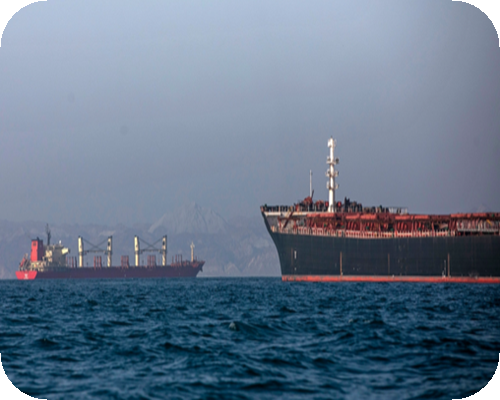
Vessels are seen anchored in Bandar Abbas, Iran, along the Strait of Hormuz (AP Photo)
Both Iranian and American officials have refused to back down over control of the Strait of Hormuz after both countries launched fresh strikes on June 27 and early on June 28, potentially scrapping a ceasefire agreement and memorandum of understanding between the two parties to end hostilities.
On June 28, Iranian Foreign Minister Abbas Araghchi said that Iran is the sole country that bears responsibility for opening the strait, which was reopened earlier in June under the memorandum, and claimed that no other country can interfere in the country’s mission, according to state-run media.
The Iranian regime was blamed for a strike on a ship in the region, prompting the U.S. military to respond this weekend by striking Iranian sites. In turn, Tehran launched attacks against Bahrain and Kuwait, two small Middle Eastern oil-rich countries located near Iran.
“Based on the memorandum of understanding, the Strait of Hormuz, under the management that Iran will adopt, will return to its pre-war capacity within 30 days, after the obstacles are removed by the Islamic Republic of Iran,” Araghchi said on June 28, according to comments carried by the semiofficial Islamic Republic News Agency.
“I ask all parties not to interfere in the issue of managing the Strait of Hormuz … and not to allow this memorandum of understanding to deviate from its course,” he said.
The Trump administration has said that Iran cannot impose controls on the strait, including fees or fines. Under the text of the memorandum that was released earlier in June, the strait must be reopened after Iran threatened or attacked ships in the waterway, a key choke point that carries roughly one-fifth of the world’s traded oil on a normal day.
Following the recent strikes, U.S. Ambassador to the United Nations Mike Waltz said that American forces will target Iranian military infrastructure again if Tehran attacks or threatens traffic in the strait.
“If the Iranian regime thinks for a second that President [Donald] Trump is going to sit by, stand by, while Iran continues to attack international shipping without a response, or our bases without a response, they’re sadly mistaken,” Waltz said on June 28 in an interview with “Fox News Sunday,” responding to a question about the Iranian foreign minister’s comments.
He said that the administration will “militarily, if needed, take down their infrastructure that they’re trying to use to illegally control an international waterway.”
“Don’t think for a second that President Trump isn’t going to leave every option on the table to achieve not just our aim, the entire world’s aim that Iran never has a nuke,” he said.
Waltz’s remarks were made after U.S. President Donald Trump warned that Tehran could “no longer exist” if the United States deems it necessary, according to a Truth Social post issued on the evening of June 27.
“United States aircraft just struck Iranian missile and drone storage locations, and coastal radar sites, for violating the Cease Fire Agreement, AGAIN!” the president also wrote. “It is very possible that they will never learn! There may come a point when we are no longer able to be reasonable, and will be forced to militarily complete the job that we very successfully started.”
In recent days, the United States and Iran have been debating the terms of an interim deal, including shipping arrangements on the strait, the removal of a U.S. blockade on Iranian ports and sanctions on Iran, and the future of Iran’s stockpile of highly enriched uranium. Under the memorandum of understanding signed this month, they have 60 days to iron out details.
Iran’s paramilitary Islamic Revolutionary Guard Corps claimed responsibility for the attacks in Bahrain and Kuwait.
Kuwait’s armed forces, which hosts a major U.S. military base, wrote on social media that it intercepted two ballistic missiles. There were no confirmed reports of injuries or damage.
The Bahraini Ministry of the Interior said that Iranian strikes damaged a residential building near the international airport. No one was killed, it said, according to local media reports.
The U.S. Central Command wrote on social media that it struck Iranian military “surveillance infrastructure, communication systems, air defense sites, drone storage facilities and minelayer capabilities” after Iran struck a ship, the M/T Kiku, earlier on June 27.
The U.S. Central Command wrote in a separate post that U.S. fighter jets struck 10 Iranian military targets inside and near the Strait of Hormuz, also in response to the strike against the M/T Kiku, a Panama-flagged crude oil tanker.