


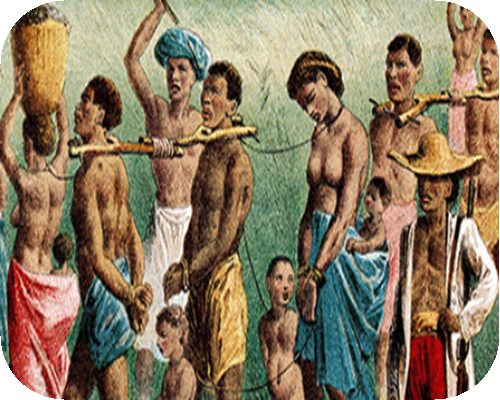
Band of male, female and child captives driven into slavery by Arab slave traders. From ”The Life and Explorations of David Livingstone” c1875. Chromolithograph (Credit Image: © PHOTO12 via ZUMA Press)
Continued from Part I.
Prof. Flaig’s chapter on slavery under Islam is called “An Intercontinental Slave System,” and points to a perceived integration of intercontinental slavery with the essence and history of Islam. Prof. Flaig does not use the terms pagan slavery or Christian slavery, but he does use the term Islamic slavery. He opens this chapter with a stark assertion: “When the Muslims conquered a global empire, they set up the biggest and longest-living slave system in world history.” (p. 83)
Prof. Flaig argues two essential points in this chapter. First, both in terms of numbers of the enslaved over time and the geographical area where Islamic slavery prevailed, its dimensions were greater than those of any other intrusive slave society. Second, by their nature, Islamic societies, at least those under Sharia law, are intrinsically disposed to favor and promote slavery, specifically slavery of non-Muslims, and that is why the greater part of the history of Islam has been the history of a rapidly expanding intrusive slave society.
[A] great expanse of sub-Saharan Africa was changed between the eighth and eleventh centuries into a “supply zone.” Slave exports in the Islamic world from the eleventh century came from the Islamic robber states (Raubstaaten), the logic of which was permanent war and enslavement. Their existence and activity transformed the whole of the Sudan, for whoever did not wish to fall victim was compelled to adopt the same predatory system. Taking prisoners was not incidental to the conduct of war, as it was in classical antiquity, but the raison-d’être . . . . (pp. 193–194)




The conquests led to the enslavement of far greater numbers than those of Republican Rome. When the Muslims conquered Spain between 711 and 720, they enslaved 150,000 people. . . . From Sind, conquered in 712, the victors exported 60,000 slaves. The second wave of expansion struck North Africa, and particularly India, where hordes of Afghan riders with their continual attacks brought hundreds of thousands of Indians into slavery. They were transported over a mountain the name of which recalls their fate — Hindukusch — “the death of the Hindu.”. . . . [T]he Sultanate of Delhi maintained up to 180,000 military slaves, of whom most were enslaved East Africans, which the Arab slave trade brought from Africa to India. The sultans led jihads into middle India every year and held practically the entire subcontinent by 1340. . . . Islamic culture, based on the import of slaves, fueled the process of enslavement on the periphery to an extent never seen before in world history. . . . The Arabian conquests created, as Bernard Lewis has clearly shown, the first “world culture,” reaching from central Asia over the Arabian Peninsula and North Africa to Spain. According to Immanuel Wallerstein, theirs was the first global economy that permitted the transportation of goods and humans over immense distances and at the core of this was the slave trade. Muslim slavery was, according to Orlando Patterson, intrusive slavery par excellence and as such to an uncommon extent dependent on the influx of slaves. (p. 85)
The numbers Prof. Flaig cites for captured slaves in the history of Islam are remarkable:
The Tartars from the Crimea enslaved, between 1468 and 1694, 1.75 million Ukrainians, Poles, Russians, and that is not counting the enslavement of Circassians and Georgians in the Caucasus. The prisoners were sold from the Crimean ports to the Ottoman Empire, about 2.5 million between 1450 and 1700. . . . [F]rom 1350 to 1550, jihads against the Balkans were practically yearly events, and from 1450 onward, Turkish fleets laid waste to the shores of the Mediterranean . . . between 1530 and 1780, enslaving about 1.2 million Europeans. . . . Mogul rule stretched into southern India and flooded the markets of central Asia with Indian slaves. . . . The Moroccan sultanate passed through the Sahara and destroyed Songhai, the largest black African ruled territory, and created plantations of slaves, which for many years were larger than the European plantations in the Caribbean. From 1565 onward, jihads [of Muslim Moros based in the southern Philippines] led to the capture of about 10,000 slaves a year in the Philippines alone, reaching 2 million within 200 years; the numbers of slaves captured in the Indonesian islands was greater still.” (pp. 89–91)
Prof. Flaig emphasizes that the more successful the search for slaves, the greater the dependence of a society on slaves captured and imported, and the greater the demand, especially when poor treatment of captives means a high mortality rate. There is also a religious aspect: the tendency to expand in search of heathens to enslave.
Had his book been longer, Prof. Flaig would probably have examined in depth the dependence of Muslim economies on slaves. Slaves were a valuable commodity, and Islamic tribes had many to sell. The greatest supply zone for Islamic slavery was Africa south of the Sahara. Ralph Austen’s estimate of 3.9 million slaves exported from East Africa by the Arabs is, according to Prof. Flaig, “definitely too low.” (p. 103) The sultanate of Oman alone, after it had become a naval power in the 16th century, was importing up to 20,000 black African slaves a year.






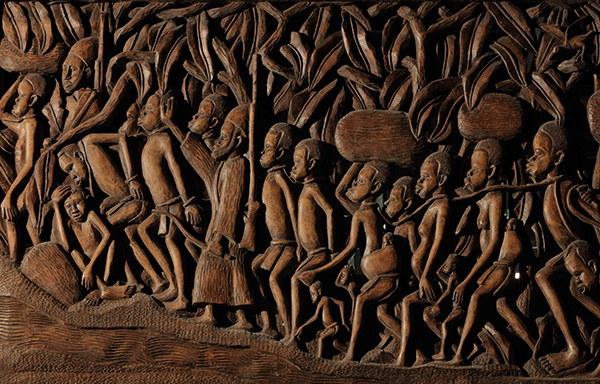
Wooden bas-relief and openwork sculpture of a procession of African slaves with Arab slave traders, by M Ulika Valentim, 1975. (Credit Image: © Manuel Cohen/Aurimages via ZUMA Press)
Prof. Flaig believes that Muslim societies were naturally disposed to become intrusive slave societies; in Islam, conquest and enslavement of the unbeliever is desirable, indeed a duty. Religious expansion and the capture of slaves became all but indistinguishable. Prof. Flaig vigorously argues an unusual thesis: slavery is inherently racist and therefore Islamic society for the greater part of its history was racist. Prof. Flaig execrates racism, but how can it be at the heart of both extrusive and intrusive slavery?
Racism for Prof. Flaig is not primarily about biology. His term for ethnic racism — “skin color racism” — is just one kind of racism. Racism in essence, according to Prof. Flaig, is the belief that certain identifiable groups are naturally inferior to other groups, that this fact justifies a permanently inferior status, and that individual qualities cannot raise members of the inferior group out of their natural status of inferiority.
“Racism has nothing to do with skin color. It arises out of a tendency present in all cultures, to devalue ‘the others,’ whose inferiority is sought in their ‘being,’ in their ‘nature’.” (p.124) Slavery itself creates differences so massive that it is impossible to overcome them. When that happens, the others are regarded as inferior to the extent of belonging practically to a different type.
To support his paradoxical argument that racism is not primarily about race, Prof. Flaig refers to Patterson’s quotation from King Chungnyol of Korea around the year 1300, objecting to proposed reforms to the slave system under the Chinese Emperor Kno-li Chi-su. Korea’s slave system was extrusive, and its slaves were all Korean, yet they were not regarded as Korean: “Our ancestors have taught us that these slave-beings belong to another race, and for that reason it is impossible for them to become normal humans.” Prof. Flaig concludes that this demonstrates that race is a pretext to justify systems of inequality, including slavery:
The [Korean] rulers considered them [slaves] to be members of another race, incapable of becoming fully fledged members of human society. That is precisely what racism is in the strict sense of the word, regardless of skin color. (p. 124)
Prof. Flaig’s definition of race and racism is extremely broad. He does not actually state that the denial of fundamental human rights constitutes racism, but it is difficult to see what other conclusion can be drawn from his definition. According to such a definition, it might be argued that a society that denies women the vote is practicing a kind of “racism”!


Prof. Flaig is in harmony with mainstream opinion in believing that racism is a matter of sociology and history, not biology.
Prof. Flaig includes a table showing that the total number of Islamic deportations out of Africa alone amounts to 17 million (there were 11.5 million trans-Atlantic deportations, with a much higher annual average over a briefer period). Some writers, such as Patricia Risso, put the number of people enslaved by Islam for military purposes alone at 20 million. Unlike trans-Atlantic slaves, huge numbers of those not selected for slavery were killed. Prof. Flaig puts the ratio of killed to enslaved in Africa at 1:1. If that is so, a staggering 34 million were killed or enslaved by Muslims in black Africa.
Prof. Flaig emphasizes the cruelty and extent of Islamic slavery in Africa. Unlike the Europeans, Islamic slave hunters were also supplying their clients with eunuchs, for eunuchs were in high demand in Islamic society. They could be trusted to guard harems, especially if the penis were also removed, and since they could never have children, eunuchs could not build subversive dynasties. Castration was carried out prior to shipment in castration centers. The mortality rate has been put by historians as high as 75 percent. Rape was standard and widespread. The unwanted — including mixed-race babies — were slaughtered.
Another difference is that many African slaves in Islamic society were captured by jihadists (Prof. Flaig does not say what percentage), whereas Europeans acquired the great majority of their slaves by exchanging Western goods with such tribes as the Ashanti, the Soninke, and the Diula. Prof. Flaig emphatically denies that the African sellers of slaves made bad deals, fooled into supplying slaves for knickknacks. Dealers demanded a high price for slaves in terms of quality goods, luxury items, and guns. African slaves were not cheap.
Whatever the exact numbers, it is clear that Islam in its history has enslaved far more people over a wider geographical range than any other system, religion, or society, and did so for a very long period (some Islamic countries made slavery illegal only after the Second World War). In contrast to European slave systems, Islam operated on the economic basis of a periphery supplying a densely populated core with slaves. The periphery would be absorbed by Islam and then the boundaries of the quest extended further.
The role of Islam in the global history of slavery is played down in universities and in historical accounts, not only by Muslim commentators but also in the West. Prof. Flaig is to be commended for drawing attention to that bias and for unfashionably insisting on the leading role played by Islam in the history of world slavery.
It is when he writes about slavery in Europe, especially northern Europe, that Prof. Flaig’s belief in the universal validity of human freedom is most apparent. At this point, the distinction between serfdom, indentured labor, and slavery becomes blurred.
The European slave trade grew from the 15th century onward. A stimulus to the transatlantic slavery of later centuries, according to Prof. Flaig, was that the crusaders had learned sugar cultivation from the Arabs. The Portuguese set up sugar plantations on islands they colonized in the Atlantic, such as Madeira and the Azores, and the discovery of gold led to mining posts along the West African coast. Both gold mining and the sugar industry were back-breaking and labor-intensive. The relationship between the demand for slaves and labor intensive industries is obvious.
However, the great majority of slaves acquired by Europeans in Africa were destined for the New World. African tribes offering slaves for trading found it more convenient to sell slaves directly to Europeans on the coast than to transport them to the north to sell to Arabs.
Prof. Flaig writes that an African king of the Congo converted to Christianity in the 16th century and took vigorous measures to prevent the enslavement of his subjects. He stopped slave caravans crossing his territory, forcing the Portuguese to move their business south, eventually leading to the establishment of the Portuguese colony of Angola.
Prof. Flaig writes that in European societies, there were “many voices” raised against slavery. The first example he gives is the declaration of the Synod of Chalons in 650 that Christians should be “entirely freed from the chains of slavery.” This was not a prohibition against all slavery, only of Christians by Christians. In 922, the Synod of Koblenz declared that selling a Christian into slavery was murder. Prof. Flaig quotes the bishop of Vercelli, who contested the ancient justification of slavery attributed to Noah’s curse from the Book of Genesis: “Slaves are not made because of the curse on Ham, a curse expiated by the Canaanites, but by the unfairness and injustice of the world.” (p. 157)
Prof. Flaig writes that the Normans abolished slavery in England. At the time of the conquest of England, 10 percent of the population were slaves, but by 1120, slavery had been entirely replaced by serfdom. This again raises the question of the definition of slavery. There is a case that serfs were akin to helots, sharing characteristics of extrusive slaves who nevertheless could not be individually bought and sold, and who preserved that sense of identity that made them likely to rebel. Prof. Flaig writes about the peasant revolts in Europe:
In these revolts, which repeatedly broke out in Europe against serfdom, the concept emerged that a human being possessed inalienable rights, that is to say, human rights. . . . A demand of the South German peasant revolt of 1525 was the abolition of serfdom with the reasoning that Christ had given his life for all, a stance denounced by Luther as solely materialistic and a threat to the natural inequality of man. (p. 159)
Prof. Flaig notes that history provides examples of a decline of slavery corresponding to an increase in forced labor and also the reverse: Serfdom replaced slavery in England but slavery increased in medieval Italy following the abolition of serfdom there. Prof. Flaig writes that Venice was the principal center of European slavery for many years, though the practice was marginal until the Crusades.
Prof. Flaig takes the island of Barbados as an example of the typical development of slavery in the New World. It is not clear why he chooses Barbados and not Brazil. By his own account, over 300 years, Portuguese/Brazilian businesses imported nearly four million slaves from Africa, amounting to about 41 percent of the transatlantic trade.
Maybe Prof. Flaig chose Barbados because it also had white indentured labor. Native labor having proven inefficient, planters began importing indentured labor from the British Isles. These were criminals, debtors or political prisoners. Between 1648 and 1655, 12,000 Irish were exported to Barbados, where they were offered no prospect of release. Prof. Flaig notes that “the case of Barbados illustrates how easily a system using white slaves could have developed.” (p. 167)
White indentured labor had major disadvantages for planters, however. The death rate in transport for white labor at 20 percent was higher than for black slaves. Also, whites were rebellious and difficult to manage, and the sickness rate was high. Planters turned to Negro slave labor because it was more docile and more resistant to tropical diseases.
Slaves were expensive, and high mortality rates during transport could reduce profits to close to zero. Prof. Flaig calculates that each slave loss represented a 0.67 reduction in profits. Nevertheless, in the early years of the trade, about 15 percent died in transport. Prof. Flaig says this figure was somewhere around the break-even point, and could not have been sustained over the long term. Traders did manage to reduce mortality, bringing rates down to about 8 percent by 1800.
Prof. Flaig also considers the transatlantic mortality rate of non-slaves at the time, something often ignored. By 1800, the approximate mortality rate for soldiers or convicts crossing the Atlantic was 15 percent, and therefore higher than the rate for slaves. Sickness, especially tropical disease, hit crews very hard: About 15 percent of the crew of French slave ships and one quarter on English slave ships would perish (Prof. Flaig does not explain this difference). Particularly hazardous for crews was time spent at anchor, waiting for supplies of slaves to arrive at the coast; in 1770, several English slave ships lost 45 percent of their crew to sickness before they even crossed the Atlantic.
Southern Europe continued to drive the European slave trade at a time when “slave-free zones” developed in middle, western and northern Europe. Prof. Flaig offers no explanation for this geographic dichotomy other than to note that Protestant sects were extremely active in the abolitionist cause. By contrast, the percentage of freed slaves was much higher in South and Central America than in North America. In 1800, 49 percent of the population of Venezuela consisted of freed slaves.
Prof. Flaig describes a major difference between the views of rulers and legislators in European nations and those of transatlantic settlers themselves. Thus, in the course of time, in France and England slavery was forbidden in the motherland while legally practiced and considered entirely normal in their New World territories. Prof. Flaig stresses that increasing the power of central authority resulted in restrictions on slavery and eventually abolition. It is not clear how much the centralization of authority was brought about by the drive to abolish slavery and how much abolition was a more or less incidental effect of centralization.
Prof. Flaig points to the exceptional natural increase in slave populations in North America compared to South America and the Caribbean. Only about 360,000 slaves were imported into British North America between 1600 and 1825, but by 1800 there were already a million slaves in North America, rising to nearly four million by 1860. Prof. Flaig explains that a milder climate and better treatment help explain the increase, and also notes that tobacco, cotton, coffee and rice required less intensive and hazardous labor than sugar harvesting, for which dangerous heavy machines turning sugar into molasses had to be run on site 24 hours a day. There was another advantage: “The diet was considerably better than the slaves’ diet on the Caribbean islands and definitely more nourishing than the diet of the lower classes in the European cities.” (p. 185)
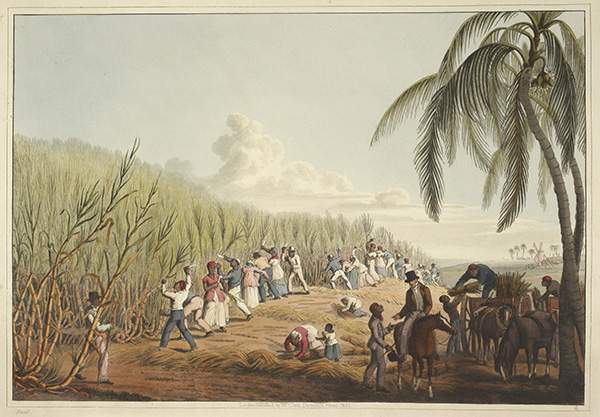
Slaves cutting sugar cane in the British colony of Antigua, 1823.
Prof. Flaig argues that discrimination on the basis of color was much sharper in North America than in South America because slaves were freed at a slower rate in the United States than in South America. In 1860, there were 260,000 freed slaves and 3.9 million slaves, a very low percentage by South American standards. Continual European immigration in the USA stymied the chances of freed slaves reaching higher social echelons. Prof. Flaig believes that “skin color racism” thus became a social vehicle for holding onto privilege. The elite class was:
eager to ensure that its social position was not imperiled in the face of a rising population of free citizens [former slaves]. New citizens had to be discriminated against and racism was a tool to be used to that end. . . . The discrimination went furthest in the USA, especially after 1830, when suffrage was extended to all white citizens. In seven states, freed slaves were obliged to leave the territory, in many places interracial marriage was forbidden. . . . (p. 189)
Upper-class whites wanted to protect their position against others — including freed blacks — and racism was a way to do so. Writing about the change from a slave society to a racially segregated one in the South, Prof. Flaig argues that “skin color racism” arises out of those rare slave systems in which slaves had a “slave culture,” by which he means a sense of community, religion, solidarity and collective identity. So, for Prof. Flaig, even “skin color racism” is the result of slavery. As he puts it, “The counterpart to slavery is the color bar.” (p.189)
It is not entirely clear whether Prof. Flaig believes that “skin color racism” can arise only out of slavery, but it seems likely that he does, for he cites Eric Williams’ thesis in Capitalism and Slavery (1944) that “racism is not the origin of slavery but its consequence” a thesis, he says “that has prevailed and is no longer controversial.” (p. 192)
Prof. Flaig’s argument about the origins of “skin color racism” ignores the racism of host societies towards immigrants of another race, and other situations in which slavery had no role in fostering racial discrimination. The evasion or summary dismissal of possible counterarguments is typical of A World History of Slavery.
Prof. Flaig writes at some length on the slave uprising on Saint Domingue [Haiti after independence], where black slaves overthrew their white masters in what he calls “the second largest [presumably, it was the Spartacus revolt that was larger] and only successful slave uprising in history.” (Prof. Flaig has evidently forgotten the successful Mamluk slave revolt of 1250). He uses Saint Domingue to illustrate two propositions.
First, Prof. Flaig emphasizes what he calls a “dichotomy” in the history of transatlantic slavery between “the periphery,” or the colonies, and “the core,” or mother countries. According to him, abolitionism originated in the core against the periphery. To illustrate his point, he writes that settlers in Saint Domingue had refused to comply with the French Republic’s decree of 1790 declaring the second generation of freed slaves on the island to be French citizens. Prof. Flaig sees a major difference here with the Islamic slave system, where he finds no divergence in attitudes towards slavery between Muslim core and Muslim periphery.
This argument has obvious implications for the history of European colonization in general. To what extent were actions against the native populations undertaken by early European settlers in accordance with or in opposition to the wishes of their home-country rulers and backers?
At the same time, Prof. Flaig argues that in Africa the drive to get colonies was largely fueled by the desire to end slavery, and this thesis calls for a reconsideration of the history of the “scramble for Africa.” The Congress of Berlin in 1884 is generally seen as primarily a diplomatic solution to disputes in Africa between the colonizing nations. The Wikipedia entry on the congress only briefly touches on the resolution to end slavery, and imputes opportunistic motives: “Partly to gain public acceptance [for colonization] the conference resolved to end slavery by African and Islamic powers.” But for Prof. Flaig, the decree was a momentous opportunity to “pursue a course of pure humanity and good will.” (p. 212)
The second proposition Prof. Flaig makes here is that in the aftermath of abolition, a slave society may well be replaced by forced labor. After successive revolts and repression, and with the help of Spanish allies, the slave uprising on Saint Domingue succeeded. However, Prof. Flaig reprints a long extract from the ordinance of the new black ruler, Toussaint L’Ouverture, himself a former slave owner, in which he announces the imposition of forced labor. Far from improving the lot of former slaves, it may have worsened it.
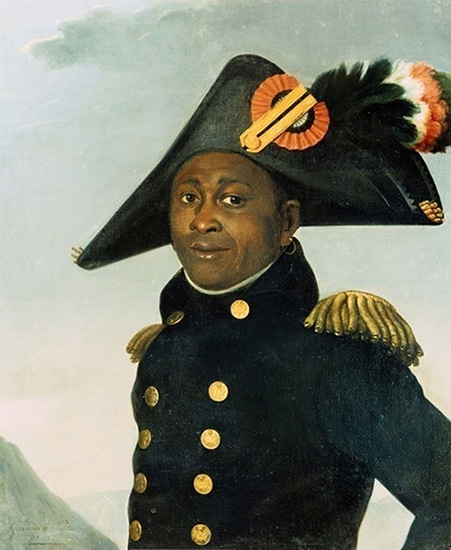
Toussaint L’Ouverture, 1813 portrait.
Ancient Rome and the Congo are two further examples in which the abolition of slavery by no means necessarily brings freedom. In Ancient Rome, forced labor replaced slavery. In the Congo Free State, Belgian King Leopold “freed” thousands of slaves, but for Prof. Flaig, it is an example of how abolition outside of colonial central control could lead to something terrible. “The crimes [in the Congo] were possible only because the Congo was the private property of the king and not a colony.” (p. 216). Prof. Flaig quotes Seymour Dresher’s assessment: “The switch from hunting for slaves to the recruitment of labor was a distinction without a difference.” (p. 216)
Prof. Flaig’s chapter “The Struggle for the Abolition of Slavery” begins bluntly: “The world has European culture to thank for the abolition of slavery.” (p. 199) It is indisputable that France and Britain, followed later by other European nations, spearheaded and completed the abolition of slavery in their dominions. To what extent this was due to the triumph of European culture is a complex question, and Prof. Flaig deals with it in a summary, even superficial and certainly polemical manner. Of Islam, he writes that only at the end of the nineteenth century,
a few Islamic intellectuals raised a critical voice against slavery, but they did not succeed in providing religious reasons against slavery and thus failed to initiate an Islamic abolitionist movement. There was no tradition within Islam to which they could appeal. . . . Sharia Islam is too heavily indebted to enslavement as the purpose of jihad. The decisive assessments by modern Islamic jurists declared that slavery is not inhuman in principle, only that at the present time it is not feasible.” (p.199)
Prof. Flaig fails to name some of the jurists who he says declared slavery not inhuman, but such declarations strengthen his argument that for Islam, slavery is an institution whose time may come again.
Who were the European abolitionists? “The principal combatants were not to be found among enlightenment philosophers but in the spiritual realm of Protestant minorities.” (pp. 199–200) Prof. Flaig also credits French republicanism to some degree.
A notable feature of North American slavery, notes Prof. Flaig, is the desire to ensure that slaves were Christian. This obviously made slaves, in a very important respect, human in the eyes of their masters, a consideration that could have rested only uneasily with the implicitly less than fully human status of the slave. This was probably a major starting point in the 18th and 19th centuries for doubts about the moral legitimacy of slavery. Without giving historical reasons other than vague statements about humanism and Protestant opposition, Prof. Flaig writes that the Northern states of the United States were unenthusiastic about slavery from the earliest days of the new nation and that within a short period slavery had nearly vanished there.
Prof. Flaig singles out Britain and France as the leaders over a hundred years in campaigns to abolish slavery and provides ample evidence of this. He cites names of Protestant anti-slavery denominations and sects, such as the Quakers, who spearheaded campaigns for abolition, but he does not explain why Protestant Britain and post-revolutionary France led the charge while the Catholic nations of Europe lagged behind.
Clearly, Prof. Flaig is not concerned with theological questions, but it would have been interesting to learn more of the role played by religious faith in general attitudes to slavery down through history. Did fundamental unchangeable inequalities continue after death? There is much evidence that skepticism on this point played a role in Christian doubts about slavery. Why did it seem not to trouble Muslims? Having himself stated that “abolitionism developed only in the West” (p. 199) and not simply the West but specifically in “the spiritual realm of Protestant minorities” (p. 200) and having himself posed the question “why was this so?” Prof. Flaig offers no answer. He certainly stresses that the British and French Empires stopped slavery not for economic reasons alone (at least not principally) but because they believed they were morally wrong. The British also criminalized suttee in 1829 on moral grounds.
In 1833, the British parliament resolved to end slavery throughout the empire; in 1841 it was put on the same footing as piracy, and plans were laid to control the seas and impose blockades “in the service of humanity,” as Prof. Flaig puts it. Following the 1848 revolution in France, slavery was declared illegal in all French dominions, with immediate effect. Fifteen percent of the British navy was used at considerable cost to operate an ultimately successful blockade of the West African coast to stop slavery. But slavery continued in the Southern American states and South America and under Islam.
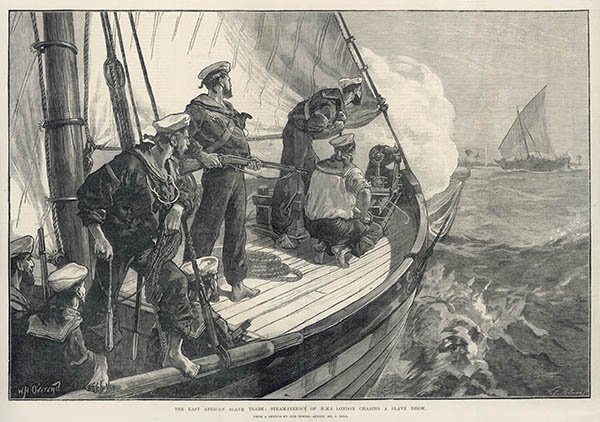
A steam-pinnace from HMS ‘London’ in pursuit of an Arab slave-dhow. (1881) (Credit Image: © Mary Evans via ZUMA Press)
At the same time, “It became ever more clear,” writes Prof. Flaig, “that intervention in Africa would be necessary to put an end to slavery.” (p. 208). Prof. Flaig’s thesis is therefore that British colonization of Africa was brought about by the campaign to abolish slavery. That certainly played a role, but Prof. Flaig may inflate its importance. He reminds us of the indisputable but often ignored fact that the spokesmen of indigenous elites leading “popular” uprisings for independence — for example the Mahdi in the Sudan — were doing so at least in part to defend the interests of slave owners who feared that the Europeans would destroy their status and their business. Prof. Flaig does not mention the possibility that anti-colonial leaders like the Mahdi might have needed the support of slave holders to create an effective anti-European coalition and that the maintenance of slavery need not necessarily have been the principal reason for resistance.
Prof. Flaig’s assertion that altruism was the principal reason for colonial action to end slavery in Africa and even for British and French colonial policy seems naive. He does not discuss the possible role played by economic and geopolitical ambitions or the unwillingness to tolerate competition from native rulers, slave owning or not. The efforts of Cecil Rhodes, for example, to ensure that British dominions stretched without a break from Egypt to South Africa, and that the Anglo-Saxon race should rule over all Africa, cannot be explained exclusively in terms of an idealistic desire to end slavery.
But Prof. Flaig is adamant:
Humanitarian motives . . . . were also the clinching factor in the decisions of the British and French governments to intervene militarily on the African continent. The motives originated in moral and political convictions, formulated in a humanitarian discourse. Was it an ideology manipulated to conceal other motives? Even when so, it placed political action under the pressure of providing moral justification. So why are so many historians unwilling to recognize it? There are manifold reasons. Marxoid [sic] social history reduces all social change to the result of personal interest and denies the role of any motive other than the economic one. . . .
So-called “anti-colonial” historians denounce the intervention on moral grounds, even going so far as to side with slave-running resistance movements. A study of the [slave-owning] Arab revolt against the [abolitionist] German occupation of Zanzibar in 1888 provides a sorry example of that kind of historiography.” (p. 217)
Prof. Flaig believes that the American War between the States was about one question only: whether slavery would triumph. (p. 209) He claims that the slave states (he writes that the South declared war on the North) had to be defeated by armed force to prevent a slave empire developing from Virginia to Brazil. He strongly believes that slave societies, far from being in decline, had been given an economic boost from a growing European demand for cotton and tobacco.
Prof. Flaig concludes his World History of Slavery with a warning pitched with polemical fervor:
The fate of human rights pivots on slavery. The many new and old forms of personal unfreedom which are spreading like epidemics in the globalized world can only be fought when slavery is seen as a crime. Only when they are suppressed as slavery was suppressed will humanity across the globe be able to base political cooperation on the basis of freedom. Failing that, the greatest victory in the history of mankind will be just a receding wave and our Western culture will be an island in time in an endless ocean of unfreedom. (p. 221)
Prof. Flaig’s is an unusual book, partly scholarly, partly polemical, and the two aspects are sometimes combined awkwardly. However, he is to be congratulated on turning the spotlight on Islam’s deep, far-reaching involvement in slavery and responsibility for it. His assertion that Islam is by its nature a religion of conquest and forced conversion, inclined by nature to create slave societies, is a challenge to apologists and proselytizers of Islam. His arguments about periphery and center and about the countercurrent working for abolition in the history of European colonialism and imperialism offer fruitful beginnings for further study. His fervent belief in the rights of man and a universal humanism is a direct challenge to the cultural relativism of both the New Left and the New Right. Those who disagree should respond to it.
A major weakness of this book is that it entirely ignores any objections that could be raised against its theses. Another weakness is that Prof. Flaig is unable or unwilling to offer precise definitions, starting with the word slavery itself, forcing his readers to guess what he means, and perhaps guess wrongly. He sometimes makes sweeping assertions without historical context. His argument that the colonization of Africa was driven by the desire to abolish slavery sounds simplistic and idealistic, just as the argument that it was all about European greed sounds simplistic and cynical.
Although Prof. Flaig writes about the economic role of slavery, he does not discuss the role that technological advance could have played in reducing its importance. If machines could do in a day what 100 slaves took a week to do, slavery was likely to become less economically viable. Prof. Flaig ignores this point.
Despite its many faults, however, A History of Slavery offers a new perspective in the study of the history of slavery and imperialism, a study which had been preempted in the 1960s by writers with a strong anti-European ax to grind. For years, their perspective has been accepted as self-evident in colleges around the world. Prof. Flaig’s book is welcome evidence that there are now academics who reject that perspective and explain why they do so.