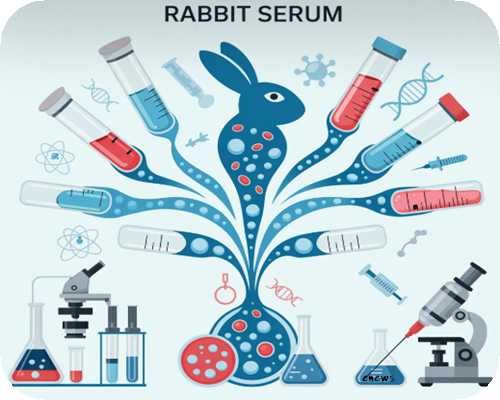
Rabbit serum remains an important biological material in laboratory medicine, translational science, and early product development. Its composition includes albumin, globulins, lipids, hormones, trace minerals, and immune proteins that support controlled bench work. Because rabbits often generate strong humoral responses, serum from this species serves several technical purposes. Laboratories use it for assay preparation, cell support, antibody recovery, and preclinical evaluation, where dependable input material helps protect data quality and interpretive confidence.
Diagnostic Value
Clinical laboratories depend on consistent serum matrices to keep assay noise low and signal behavior steady across repeated runs. During reagent preparation and control setup, sterile filtered rabbit serum is often chosen because careful filtration reduces particulates, limits incidental contamination, and supports cleaner handling through dilution, incubation, and wash steps. That matters in diagnostic work, where slight shifts in protein balance, turbidity, or background staining can alter binding patterns, optical readings, or recovery measurements.
Research Support
Basic science groups use rabbit serum as a supplement, blocking material, or reference source in many experimental systems. Its protein content can stabilize fragile reagents during mixing, short-term storage, and repeated handling. Early studies often depend on reliable starting inputs before protocol variables are narrowed. When lot characteristics remain steady, investigators can compare adhesion, uptake, proliferation, and binding behavior with fewer doubts across repeat experiments.
Antibody Generation
Rabbit serum plays a central part in antibody programs because rabbits commonly produce broad, high-affinity immune responses after antigen exposure. That trait helps scientists obtain antibodies against small molecules, altered peptides, and weakly immunogenic targets. After collection, serum becomes the starting material for purification, specificity testing, and downstream characterization. Clean, well-documented lots help support yield planning, binding assessment, and screening decisions before larger validation studies begin.
Cell Growth
Certain primary cells and specialized lines respond well to rabbit serum during adaptation, maintenance, or recovery after environmental stress. The fluid provides carrier proteins, attachment factors, micronutrients, and hormonal signals that can support survival and membrane stability. Investigators usually test concentration ranges before finalizing a culture method. Even a modest serum adjustment may influence morphology, doubling rate, nutrient use, or marker expression across later passages.





Assay Controls
Quality teams also use rabbit serum for standards, negative controls, and matrix-matched comparison studies. These exercises help determine whether an assay detects the target or reacts to unrelated serum constituents. Heat-inactivated material may be preferred when complement activity could distort readouts. Parallel review of treated and untreated lots can reveal matrix interference, alter recovery values, or shift background staining in highly sensitive analytical workflows.
Therapeutic Development
Drug development teams use rabbit serum during preclinical formulation work, bioanalytical method checks, and compatibility testing. Serum exposure can reveal protein binding behavior, stability changes, or interference risk before later studies become broader. Developers may incubate biological candidates under serum conditions to monitor aggregation, fragmentation, or potency decline across time. Those observations help guide buffer selection, storage planning, and release-test design during early manufacturing preparation.
Quality Benchmarks
Material quality influences performance more strongly than many laboratories first expect. Useful review points include sterility status, filtration approach, heat treatment, appearance, hemolysis level, total protein, endotoxin burden, and lot records. Each attribute can affect a separate outcome. For instance, excess particles may disrupt optical measurements, while hemolysis can change sample color, release intracellular contents, and complicate interpretation during validation or troubleshooting work.
Supply Decisions
Selection usually depends on intended use rather than one universal grade. Diagnostic reagents may require cleaner filtration and tighter batch documentation. Cell systems may perform better with screened lots that show stable growth support during qualification. Antibody efforts often focus on recovery, immunoglobulin content, and post-collection handling quality. Clear supplier data, matched certificates, and retained reference samples help teams compare later lots against earlier baseline performance.
Conclusion
Rabbit serum continues to support diagnostics, bench research, and therapeutic development because its biological profile fits many controlled laboratory tasks. Functional proteins, immune-derived components, and broad procedural compatibility give it lasting technical value. Stronger outcomes usually follow when teams match serum grade to the actual application, review quality records before procurement, and confirm performance through fit-for-use testing. With that discipline, rabbit serum helps sustain reliable workflows, clearer interpretation, and sound technical judgment.