



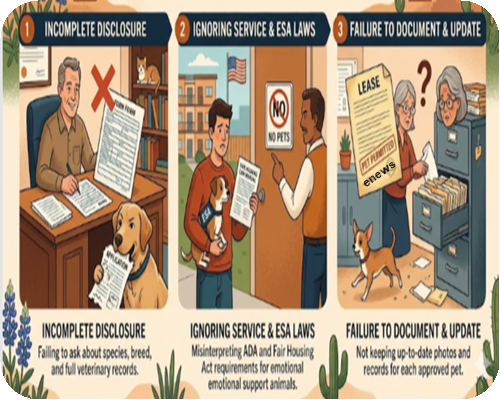
When you’re considering whether or not to permit pets in your rental unit, you’re probably aware that your answer is rarely going to be a simple yes or no. The goal of pet screening in Texas is twofold: to protect your property by preventing pet-related damage and to ensure that everyone is treated fairly. However, it is easy to find yourself in a situation where a simple mistake can quickly escalate into an issue that leads to disputes between you and your renters, or even pose legal threats.
The good news is that most of these issues can be avoided if you know what to look for when screening pet applicants. This article provides some of the common mistakes landlords make when screening applicants for pets, along with helpful information you can use to help prevent these mistakes from happening to you.
Overview of State and Local Laws Affecting Pet Policies in Rental Properties
In Texas, pet policies for rental units must comply with federal and state housing laws and applicable local regulations. Refining your rental application is one of the essential ways to secure a rental property. You may set out in your lease what is approved, but the lease terms must still comply with various housing laws at all levels.
A significant aspect to take into account is that, under state or federal law, emotional support animals & service dogs are not pets, so most pet rules don’t apply to these two categories of animals. Assistance animal protection under fair housing requires you to typically permit assistance animals on your property, even if you do not allow pets.
However, there are certain limitations you may have regarding animals being allowed on your rental property. Additionally, all assistance animals must abide by local leash laws & be vaccinated as required by the local law. The confusion about where your rental policies end and the law begins leads to possible issues.





Common Pitfalls in Texas Pet Screening
-
Overly Restrictive Pet Policies
If you enforce pet restrictions that make it hard for tenants to move into your unit, you’ll have a problem. Rules such as excluding certain breeds, imposing very low weight limits, or even banning pets outright and allowing no exceptions will unduly limit your ability to rent to responsible tenants who would have been a great fit.
On top of that, the likelihood of experiencing a fair housing issue increases when service or emotional support animals are involved, due to overly strict policies. From a practical perspective, when you create excessive rules, you may end up with tenants who are less forthcoming in their applications or even mislead you, rather than provide an accurate account of their applications.
-
Inconsistent Screening Practices
Being inconsistent in screening all pets is one of the more common errors an owner will make. An owner may decide to approve one tenant’s dog on a whim, yet request detailed documentation from another tenant. Inconsistency in screening methods could create problems for both the owner and the tenant when a tenant with an approved dog pursues a dispute over their approval.
In Texas, it is up to you to establish the rules regarding pets in your community, but you must have clear rules and enforce them consistently for each tenant. When a tenant requests an assistance animal, the rules and policies established become even more critical. Treating similarly situated tenants differently, or imposing “pet” rules that do not apply to assistance animals, can lead to legal issues.
The solution here is to maintain uniformity and consistency throughout the approval process. When every request goes through the same application process, it reduces confusion, increases your protection against legal issues, and helps you build better relations with your tenants.




-
Ignoring Documentation and Verification
An often-seen error is the lack of documentation or receiving something without verifying it first. It may feel quicker to trust a verbal explanation or an online document, but this is where issues begin. This can be particularly true for animals intended to provide emotional support. Support animal letters should come from a qualified healthcare provider, rather than from an internet-based service that issues certificates.
On the other side, do not overstep your bounds. You cannot require a service animal to present formal documentation, but there is a fine line between fulfilling your requirements for a service animal and staying compliant. The key to this is: only validate information within your rights or authority, and be sure to pay attention to detail. Failing to verify a document’s validity could result in serious legal problems later.
-
Mismanaging Pet Deposits and Fees
The primary pitfall for landlords is believing that pet deposits and pet fees are the same thing. They surely aren’t. A deposit is generally meant for damage that occurs, and if there’s no damage to your property, your tenant should get their deposit back. A fee, on the other hand, is typically non-refundable. If you were to mix these two up or fail to clearly define them in your lease, it could create confusion for you and your tenant, as well as lead to future disputes.
There are also landlords who charge both a deposit and a recurring pet fee without realizing that the current law is unclear on whether charging both is permissible. Some landlords may be able to charge both, while others can charge only one or the other.
Landlords can create an additional problem when charges are deemed excessive or unclear. While Texas does not have a significant cap on pet fees or deposits, unreasonable charges could cause you to lose a good tenant or generate numerous tenant complaints. Be sure to keep your lease terms as straightforward and reasonable as possible, and write them out in advance to help avoid headaches.
Final Thought
Pet screening is a process that should take careful thought. Consistency across properties, understanding what the law allows for pet screening, and having a clear & fair screening process will help you prevent many problems that arise later with pet screening.
Rather than having rules, it is more about making the best decision possible for everyone. The basic goal is to protect your property while being reasonable for everyone. When you do a good job of balancing these two goals, the move-in process will run much more smoothly than if you do not.