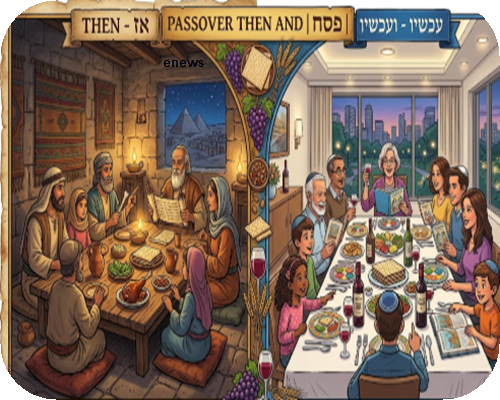
Passover begins at sundown on Wednesday, April 1, and I am filled with thoughts about traditions we still cling to and new ones we’ve invented. It is a true “popposite,” which is a word I invented in one of my novels. “Popposites” occur when things are connected but
opposite, and it’s that exact tension that provides us with extra “pop.”
For example, you are excited about your first nibbles of matzah, which is crisp and can be used for any dip or protein of your choosing. But two days into the eight-day holiday, you are done with the matzah. Well, not really, but you feel you should be. Matzah now feels boring and tasteless, a sign that the holiday has run its course, even if it hasn’t.
Another popposite: We have a seder where we discuss the story of the Jews’ exodus from Egypt. They had been slaves under Pharaoh, a story we retell using the Haggadah. However, to actually pull off a seder with all its component parts is so much work that while you celebrate freedom, you feel enslaved by the meal preparation required.
The truest popposite of all: I both love the holiday, and I fear it. I love that it takes me back to being a kid and celebrating the holiday with my siblings and parents. We had so much fun and derived so much meaning from the story and the rituals.
I fear the holiday because of its emotional toll. It is long and exhausting, and we’ve built it up over time with new complexities. Still, it is one of the most important Jewish rituals of all, and I make sure to hand it down in the fullest way I can.





For a long time, now, we don’t just use the Haggadah. Now we let everyone bring their content and stories to add personal meaning. This can be good, but it can make a long night longer, and not everyone is disciplined in picking stories and moments that jibe with the holiday.
Maybe you had a splendid vacation in Jamaica. Great, but not seder-worthy.
Maybe your children drew their favorite sports teams. Also great, but not seder worthy. To reel in that moment, with a Passover message, we would have to add, “they were free to draw.”
Weak…
Sometimes, modern-day politics will make its way into the discussion. This is a very quick way to make a sweet and historical celebration turn dour. Maybe I need to see the moment as a “popposite.” We are simply working to make the holiday feel relevant.
What has stayed in our observance of the holiday?


Early in the seder, we cite the “Four questions” that ask why this night is different from all other nights. It is tradition that the children sing this paragraph in the Haggadah. This still happens, though it has always felt like significant pressure on the young kids, and, in 2026, we are sensitive to emotional burdens. Now, we have them start us out, and then we all sing it together.
There is a very moving moment in the seder that my dad always had my youngest brother read, both in Hebrew and English. It reads as follows: In every generation, each person must regard themself as if he or she had come out of Egypt. It is a moment of empathy, identity, and a promise to continue doing the hard work of freedom. That moment will forever stay in my seders — past, present, and future.
The end of the seder is filled with many songs, but for many, experiencing the first half of the seder is sufficient.
We have a song for that expression of it being sufficient when we sing “Dayenu.” The song is the biggest hit of the seder parade because of the sentiment, and you don’t need to be fluent in Hebrew to sing in the chorus, which is all of one word: “Dayenu” which means “enough.”
Usually, after we sing Dayenu, some thoughtful individual will ask the inevitable question, “Would it have been enough?” Then someone else will probe for a modern-day equivalent of the Dayenu sentiment, and we’re off to the races.
Conversation, different perspectives shared, more song, more conversation, and then fatigue.
That last part is the same, year after year.
“Year after year” — that’s the good news, right? Continuing on with meaning, tradition, and practice that evolve with the times. Dayenu.