

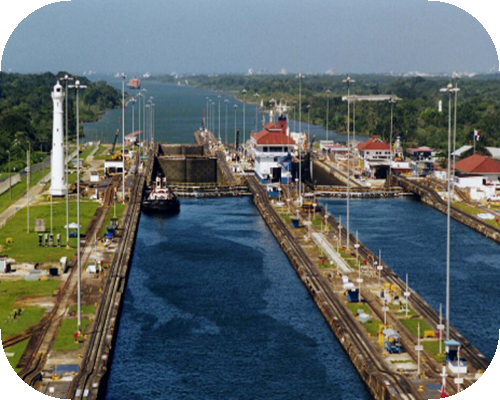
I spent a week reporting from the Panama Canal, watching massive container ships inch through the locks as engineers and pilots explained the delicate choreography that keeps one of the world’s most important trade corridors operating. Built by the United States more than a century ago, the canal connects the Atlantic and Pacific oceans, saving shippers thousands of miles, millions of dollars and weeks of travel.
Beyond the engineering feat, it reshaped global commerce and extended American influence far beyond its shores.
Today, the world’s geopolitical competition is less about ideology and more about infrastructure — who builds the ports, power systems and trade corridors that determine how goods, energy and capital flow across the planet. The Cold War was fought over capitalism versus communism. This century’s contest is increasingly about who builds the world’s infrastructure.
As Deborah Brautigam, professor emerita of international political economy at Johns Hopkins, has noted, evidence shows that many developing nations choose Chinese infrastructure financing and generally view those projects positively — and that the widely repeated “debt-trap” theory is often exaggerated.
Through its Belt and Road Initiative, China has signed cooperation agreements with about 150 countries and committed more than $1.3 trillion to projects ranging from ports and railways to power plants and highways. In 2025, Chinese companies signed $210 billion in new deals.






These projects aren’t just overseas; they create jobs and opportunities for Chinese construction, engineering and equipment firms, and expand trade networks that tie China more closely to the developing world.
China’s business leaders and policymakers stress that these projects are meant to spur economic activity abroad and at home. Their underlying theme: infrastructure diplomacy bolsters China’s global influence while shoring up key domestic industries.
For many developing nations, the appeal is straightforward. Roads, ports and reliable electricity are essential for economic growth, yet financing such projects is often scarce. Belt and Road investments fill a gap left by the United States, allowing developing nations to build projects critical to energy and trade.
To be sure, China’s overseas infrastructure push has faced criticism. Some countries have taken on heavy debts, raising concerns about financial sustainability. Some warn that China could gain excessive control over strategic ports and railways, giving it outsized influence over global trade networks.
Despite these concerns, many governments continue to welcome the investment because few alternatives exist that offer speed and scale.






Meanwhile, the United States has pulled back from some of its traditional development roles. For decades, American influence abroad was built not just on military power, but on programs like the U.S. Agency for International Development, which financed ports, roads and power grids, while also providing humanitarian support.
In 2025, USAID was dismantled, cutting billions of dollars in global programs overnight — eliminating one of America’s most cost-effective tools for projecting influence in the developing world. Washington does maintain the U.S. International Development Finance Corp., created specifically to compete with Belt and Road — but its project approvals have slowed to a fraction of those in prior years.
Global strategist Parag Khanna has long argued that the defining force of this century is not ideology or military might but connectivity — the transportation networks, energy grids and supply chains that knit economies together. In what he calls “connectography,” infrastructure rather than borders increasingly maps where influence and opportunity lie.
By that measure, walking away from infrastructure investment may save money on paper, but the long-term cost is detrimental: it surrenders the map.
Infrastructure projects have a demonstrated history of boosting trade, strengthening alliances, and projecting soft power. China clearly sees this opportunity and is stepping in where the U.S. has pulled back, building global networks that connect commerce, politics and energy to its own benefit.
Standing beside the Panama Canal, it was easy to see how infrastructure can shape the world for generations. The canal transformed global trade and extended American influence worldwide. Today, a new generation of ports, power plants and trade corridors is reshaping the global economy. The question is whether the United States intends to help build them — or simply watch as others do.