

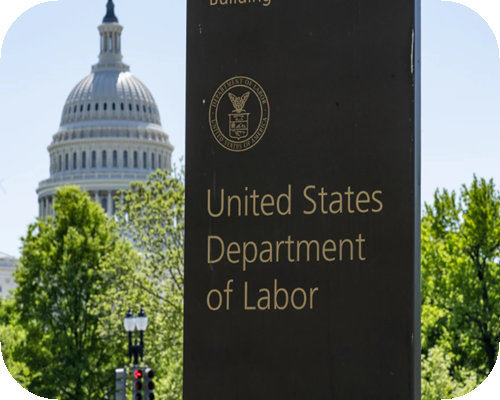
The U.S. Department of Labor headquarters in Washington (AP Photo/J. Scott Applewhite, File)
The Department of Labor (DOL) on March 27 proposed a rule that will raise wage requirements for employers hiring H-1B visa holders and other employment-based immigrants, aligning their pay with that of similarly employed American workers.
The DOL said the proposed rule will revise how “prevailing wage levels” are determined in permanent labor certification and visa programs, including the H-1B visa, which allows employers to hire foreign workers in specialty occupations; the H-1B1 visa, which covers workers from Chile and Singapore; and the E-3 visa, which applies to employers hiring Australian workers in specialty occupations.
The department said the proposed rule was intended to curb abuse of certain visa programs by reducing the incentive to displace American workers with lower-wage foreign labor and aligning wages paid to local and foreign workers.
“The Trump Administration is committed to ensuring that American workers are not disadvantaged by unfair wage practices,” Secretary of Labor Lori Chavez-DeRemer said in a statement.






“This proposed rule will help ensure that employers pay foreign workers wages that reflect the real market value of their labor, in addition to protecting the wages and job opportunities of American workers.”
In its Federal Register notice, the department proposed increasing the prevailing wage floors for Wage Level I from the 17th percentile to the 34th percentile and Wage Level IV—which is the highest—from the 67th percentile to the 88th percentile.
The DOL said the increase is necessary because the previous methodology set prevailing wages “too low” by relying on a methodology that failed to account for factors such as experience, education, and level of supervision, as required under the Immigration and Nationality Act.
Prevailing wage levels refer to the average rate of wages paid to similarly employed workers in a specific occupation, according to the department’s website.
“As a result, employers were permitted to hire alien workers at wage levels below those that similarly employed U.S. workers were paid, resulting in adverse effects to the wages and working conditions of U.S. workers,” it stated.






The proposed rule is open for public comments for 60 days following its publication in the Federal Register on March 27, according to the DOL statement.
In September 2025, President Donald Trump issued a proclamation introducing a one-time $100,000 fee for H-1B visa applications.
The proclamation states that the visa program was designed to bring in foreign workers on a temporary basis “to perform additive, high-skilled functions, but it has been deliberately exploited to replace, rather than supplement, American workers with lower-paid, lower-skilled labor.”
“The severe harms that the large-scale abuse of this program has inflicted on our economic and national security demands an immediate response,” Trump wrote in the proclamation.