

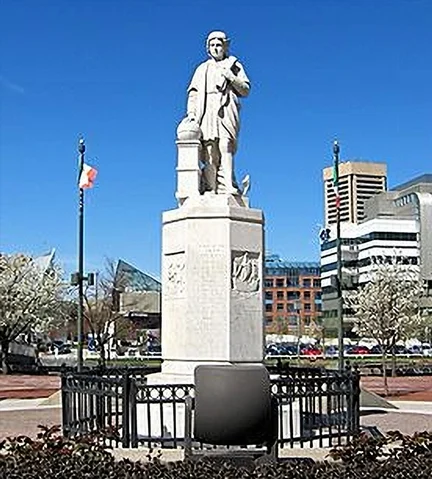
July 4, 2020, a date of infamy for the American public square. In the narrow streets of Baltimore’s Little Italy, a mob took control. Lawless energy reigned. Shouts of malice filled the air while ropes wrapped around a statue. One night of rage — that was the attempt at deleting the past.
Vandalized and ripped from its stone pedestal, the Christopher Columbus Monument was dragged across the pavement. It hit the ground. The sound of stone cracking on asphalt signaled a deeper fracture in the national spirit. The crowd celebrated the wreckage. Then, the crowd dumped the broken marble into the Inner Harbor as if it were refuse. For four years, that empty pedestal stood. It was a warning of a government frozen, declaring history negotiable and heroes an embarrassment.
The momentum reached a new point this month. At the gates of the White House, the humiliation ended. A 13-foot marble monument now stands as a necessary assertion of pride. They tried breaking the past with malice; the nation answered with marble and resolve.
This conflict involves more than a single man or a block of stone. It is a war on the idea that progress requires courage. Erasing Columbus is an attempt at erasing the principle that bold discovery drives civilization forward. The message sent is clear: heritage is a burden, and admiration for achievement is a crime. The protesters weaponize guilt, replacing gratitude with resentment.
This strategy seeks to turn citizens into squatters within their own country. Painting the voyage of 1492 as a villainous deed remains a thread that unravels the entire American experiment. Discovery being a crime makes the Republic stolen goods.






This effort delegitimizes the West. It tells every citizen that the foundations of their society are fundamentally unjust.
Every reconnected fragment proves the durability of the West’s heritage. It shows that the core values of the Republic remain intact even under direct assault.
Every crack in the stone tells a story of resilience. It is a true resurrection from the harbor floor. This restoration sends a clear, uncompromising message. History remains. Heroes remain beyond a veto. 1492 remains a triumph. Columbus did more than cross an ocean; he connected worlds. He seeded the ideas that made the American experiment possible. Without 1492, the New World would remain a mystery. Without the New World, the United States would remain nonexistent. Without the United States, liberty remains a stranger across the globe.
The strategy seeks to turn citizens into squatters within their own country. They erase, they cancel, they rewrite. This effort delegitimizes the West. Painting Columbus as a villain remains a thread that unravels the entire American experiment. This narrative turns a historical explorer into a political target used to discredit the past.
These voices push a view of American origins as fundamentally unjust. This is evident in the 1619 Project, which places slavery at the center of the nation’s founding story. The narrative demands rejecting traditional accounts.






Yet, Columbus discovered America. The Library of Congress documents this in the “1492: An Ongoing Voyage” exhibit. That moment created the foundation for the greatest experiment in human liberty known. Columbus was the bridge between the civilized world and the uncivilized wilderness. This connection allowed the seeds of Western thought to take root in new soil.
Replacing Columbus Day with Indigenous Peoples’ Day is a deliberate insult. It swaps accomplishment for grievance. It replaces the spirit of curiosity with a culture of complaint. This shift shows that achievement is a target and guilt is a civic requirement.
Critics obsess over the flaws of a 15th-century man while ignoring the prosperity his actions indirectly created. Every statue torn down and every lesson rewritten proves that the goal is ideological intimidation. It places tribalism over the universal advancement of Western civilization. They erase, they cancel, they rewrite. The nation must choose: remember triumph or succumb to shame.
Apologizing for the expansion of the frontier is now called a duty. That expansion created the prosperity these critics currently enjoy. This produced guilt behaves as a poison. It leeches the pride from the people. It replaces gratitude with resentment. To break such a cycle, defending the men who dared to sail into the unknown is a constant necessity.
Defending the past remains a necessity for any civilization that intends to survive. Every monument rebuilt and every story told straight pushes back against the vacuum of a culture seeking destruction. Honor belongs to explorers.
This is a declaration that courage, vision and the ideas of the West endure. American history will refuse kneeling. The heroes of the West will refuse to vanish. The year 1492 remains a milestone, unbroken and unashamed. The Columbus Monument stands again. It stands as a sentinel at the gates, proving that the spirit of discovery is beyond the reach of any mob.