


Lost in the conversation about how advances in AI could alter economies or shrink workforces is a startling fact: in less than ten years, the U.S. will need around $10 trillion to build the infrastructure required to support it, including roads, railways, and ports.
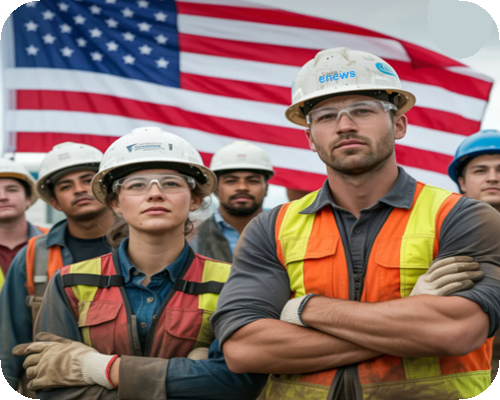
Obviously, the U.S. needs more than monetary capital. What’s needed is a scalable, skilled workforce. In fact, the projected demand for skilled trades is so great it has been dubbed a “blue collar gold rush.”
I spent a career in the Phoenix (AZ) Fire Department. I know what it means to show up, do the work, and count on a system that has your back. The men and women in America’s building trades live that same reality every day. They have long delivered the high-quality, large-scale projects that underpin economic growth, and they will be essential to executing this next wave of infrastructure investment. Meeting the demand must include firm commitments to union labor to ensure family wage jobs exist as part of the AI infrastructure revolution.
Anticipating these challenges, BlackRock recently brought together leading voices in the public and private sectors for an Infrastructure Summit to discuss both the coming boom and the workforce needed to sustain it. Backing that commitment, BlackRock announced a $100 million investment to expand training programs in the skilled trades.
The Summit elevated the voices of labor leaders who understand the workforce challenge firsthand, including representatives from North America’s Building Trades Unions who emphasized the need for strong labor pipelines, apprenticeship programs, and policies that prioritize American workers.






Just as important to the infrastructure conversation is how we connect this investment to retirement security. That’s why I lead the Alliance for Prosperity and a Secure Retirement. Retirement savings don’t grow in a vacuum. They grow when businesses expand, workers are gainfully employed, and productivity rises.
As AI demands more energy grids, data centers, toll roads, broadband networks, and water systems, infrastructure won’t just serve as the backbone of our economy – it can also become a cornerstone of long-term financial security.
When structured correctly, infrastructure investments can provide some of the most stable, long-term opportunities available – and they have the potential to benefit the very workers building these assets.
Why do infrastructure assets make sense for retirement? They generate predictable cash flows from long-term contracts. They move differently from stocks and bonds, which means real diversification. They carry built-in inflation protections. And their long investment horizons match what pension funds and savers actually need.
Many institutional investors have been steadily increasing their allocations to infrastructure for these reasons, viewing it as a strategic way to diversify and better match long-term liabilities.






Access remains uneven. Roughly 57 million working Americans, especially those in lower-wage or part-time roles, have no access to employer-sponsored retirement plans. When plans do exist, the options available to ordinary Americans, including the firefighters, police officers, and teachers I’ve spent my career fighting for, often pale in comparison to those available to large institutional investors.
Groups like the Center for American Progress (CAP) and the Economic Policy Institute have explored how infrastructure investment initiatives that emphasize job creation and strong labor standards can create a genuine win-win for workers and investors alike.
According to CAP, countries like Canada, Australia, and many in the European Union are moving more aggressively to modernize infrastructure while leveraging public-private investment strategies to fund it. The case for aligning workforce development with infrastructure spending has drawn support from across the political spectrum. American Compass, a center-right policy organization, recently published “Learning By Doing,” a series of case studies showing how apprenticeship programs, employer-led training, and union-industry partnerships are building the skilled workforce America needs. One case study highlights the collaboration between Micron Technology and North America’s Building Trades Unions, exactly the kind of earn-and-learn pipeline that should be connected to long-term retirement planning.
None of this is automatic. The retirement savings gap is the result of a system that has too often prioritized access to sophisticated investment opportunities over the financial security of hardworking Americans. Now there is an opportunity to change that.
To be clear, infrastructure assets can be complex or illiquid, which means they are not a simple plug-and-play solution. But pairing these policy efforts with a deliberate strategy to connect workers – especially union workers building this infrastructure – to the long-term value those projects generate is the real opportunity in front of us.
If we get the oversight, access, and design right – prioritizing fiduciary responsibility and ensuring workers aren’t left behind – infrastructure investments could help strengthen our economy and the retirement security of millions of Americans at the same time.
The same workers who will build the infrastructure powering the AI-driven economy should have a fair shot at benefiting from the long-term returns those assets generate. Aligning those two goals is not just good policy – it’s common sense.