


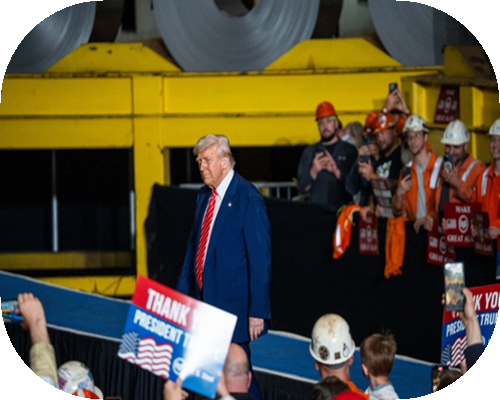
President Donald Trump arrives to deliver a speech at the U.S. Steel Corporation–Irvin Works in West Mifflin, Pa., on May 30, 2025. Madalina Vasiliu/The Epoch Times
Optimism among U.S. manufacturers about their companies’ outlook is rising despite persistent business challenges, the National Association of Manufacturers (NAM) said in a March 12 statement.
According to NAM’s Q1 2026 Manufacturers’ Outlook Survey, 75.3 percent of businesses reported a positive outlook for their company, up by 5.4 percentage points from the previous quarter.
“For the first time since 2023, manufacturers’ outlook topped the historical average of 74.3 percent, and manufacturers expect most indices to improve meaningfully over the next 12 months,” NAM chief economist Victoria Bloom said.
“Sales and production are projected to rise 3.8 percent and 3.5 percent, respectively, up from the previous quarter’s forecast of 2.8 percent and 2.4 percent growth.”






However, businesses said they were facing challenges. More than 70 percent of manufacturers cited trade uncertainty as a top business challenge. Rising health care/insurance costs were the second-most-cited issue.
Many businesses also do not anticipate raw material and other input costs slowing, with more than 57 percent citing this as a key problem.
Amid concerns about trade uncertainty, over 54 percent of manufacturers said they source critical inputs from either Canada or Mexico. Among businesses sourcing from these nations, 62.7 percent said they benefit from a strong customer base on the other side of the border.
The manufacturers’ concerns come as the United States–Mexico–Canada Agreement (USMCA) is up for review in July.
If the three nations agree to renew the agreement at the upcoming talks, the deal would remain in effect till 2032. However, if there is no renewal, USMCA could enter a period of annual review.






Alternatively, if one or two nations withdraw from the deal, the United States, Mexico, and Canada may then end up making bilateral agreements.
In an interview with Bloomberg last month, White House trade adviser Peter Navarro said there were “significant issues” with the USMCA deal. However, he stopped short of suggesting that President Donald Trump was looking to scrap the agreement.
According to NAM, the majority of items imported by U.S. manufacturers from Canada and Mexico are industrial inputs such as raw materials, equipment, and machinery. Mexico and Canada also buy up a third of the manufactured goods exported from the United States.
“Manufacturers are ready for liftoff, but the skies need to clear,” NAM President Jay Timmons said. “This quarter shows a mixed bag of results with real momentum from tax reform, regulatory rebalancing, and energy policy.”
“At the same time, the results underscore how essential durable supply chains are to manufacturing success—and how critical Canada and Mexico are to that system, which is why we need to preserve and strengthen the USMCA.”
Protecting Domestic Industries
Meanwhile, to protect American industries from unfair trade practices of other nations, the Trump administration announced new investigations on March 11 against several countries.
The first probe will focus on trade practices related to excess capacity and production in other nations’ manufacturing sectors.


Countries subjected to this investigation are China, the European Union, Singapore, Norway, Indonesia, Malaysia, Cambodia, Thailand, South Korea, Vietnam, Taiwan, Bangladesh, Mexico, Japan, and India, U.S. Trade Representative Jamieson Greer said in a call with reporters.
“The Trump Administration’s reindustrialization efforts continue to face significant challenges due to foreign economies’ structural excess capacity and production in manufacturing sectors,” Greer said, according to a March 11 statement from the Office of the U.S. Trade Representative.
“Across numerous sectors, many U.S. trading partners are producing more goods than they can consume domestically. This overproduction displaces existing U.S. domestic production or prevents investment and expansion in U.S. manufacturing production that otherwise would have been brought online.”
The second investigation will focus on imports that are produced with forced labor. This will target roughly 60 nations and could eventually lead to a ban on the import of such items, Greer said.
Both probes are being conducted under Section 301 of the Trade Act of 1974, which could result in tariffs being slapped on certain countries.
In a March 11 statement, the Alliance for American Manufacturing welcomed the Section 301 investigations.
“Overcapacity is a serious problem. In some cases, such as Chinese autos and steel, it has wrecked economies and industries as well as cost jobs in America,” Scott Paul, president of the group, said.
“We commend the administration for initiating these investigations, which we hope will lead to meaningful action to defend American workers and manufacturers.”