

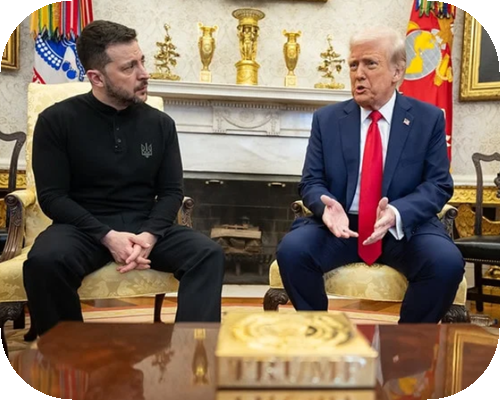
President Donald Trump and Ukrainian President Volodymyr Zelenskyy at the White House, February 28, 2025 (CREDIT: White House)
The notorious Oval Office meeting between President Trump and Ukrainian President Volodymyr Zelensky took place a year ago Feb. 28. The meeting, publicly live-streamed and then covered repeatedly here and abroad, had many unforgettably painful moments: Vice President JD Vance scolding Zelensky for his alleged ingratitude, Trump telling Zelensky he had no cards to play, Zelensky being unceremoniously shown the door ahead of schedule.
One point received little attention then and is largely forgotten today: Trump’s focus on Putin’s alleged “suffering” at the hands of Western politicians and media. Today, in the wake of the Trump administration’s freshly unveiled “new world order” and another round of inconclusive Ukrainian-Russian peace talks, this is a point worth reexamining.
At that meeting, Trump brought up Putin’s suffering twice. First, he claimed that Putin “had to suffer through the Russia hoax — Russia, Russia, Russia. It was all Biden. It had nothing to do with him. He had to suffer through that.”
Later, toward the end of the meeting, Trump was asked how he could trust Russia to honor a new ceasefire agreement, given that it had broken past agreements. He heatedly answered that Russia “broke it with Biden because they didn’t respect him. They did not respect Obama. They respect me. Putin went through a hell of a lot with me. He went through your phony witch hunt. They used him and Russia, Russia, Russia, Russia. That was a phony Hunter Biden, Joe Biden scam. … He had to go through that. He did go through that.”





Trump’s attention to the supposedly hurt feelings of this world-class tyrant is puzzling for several reasons. From the standpoint of morality, Putin’s hurt feelings should be of no concern, except perhaps to the extent that they might hinder some forthcoming negotiations. From the standpoint of negotiating (supposedly a key skill of Trump), concern with an adversary’s feelings is a quick way to handicap yourself from the outset.
So what was going on here? Was Trump genuinely concerned about Putin’s well-being? Was he a fanboy eager for Putin’s approval?
One could argue that Trump’s fixation on Putin’s sensitivities has been disproved by the major actions he’s taken this year that run counter to Russia’s interests — Trump’s bombing of Iranian nuclear facilities last June, his statements on Greenland, and his take-down of Venezuelan President Maduro.
While it’s true that Moscow condemned these actions, each of them could be seen, in a way, as aiding Russia by legitimizing its own aggression against Ukraine.
For example, Moscow might accept Greenland and Venezuela as falling within the United States’ sphere of influence under a revived Monroe Doctrine (or, as Trump now calls it, the “Donroe Doctrine”). By acquiescing to these U.S. activities despite its public protests, Moscow could be trying to set yet another precedent in pursuit of its own goals in Ukraine.





Similarly, the U.S. treatment of Iran as a threat could be a helpful analogy to Moscow’s dealings with whatever threat it sees in Ukraine. In short, these counterexamples don’t necessarily demonstrate that Trump has gained newfound independence from Putin.
On the other hand, what isn’t questionable are the occasions when Trump’s actions led to the popping of champagne corks in Moscow. That, in fact, is the very phrase used in two different news reports on how Russian officials reacted to Trump’s reelection and to his turnabout on Ukraine. And these officials were cheered, at least privately, by the international tensions sparked by Trump’s tariff campaign and the strains within NATO stemming from his renewed push for Greenland.
Trump’s admiration for Putin didn’t begin when he first ran for president. Years before, Trump had occasionally commented on Putin’s effectiveness as a leader. These statements were in the context of Putin as an adversary of the United States. In contrast, last February’s Oval Office meeting made it clear that Trump had shifted dramatically. He now sees Putin no longer as an adversary but a partner, their bonds forged in mutual battle against some enemy in Western society.
A partnership like this spells trouble, to put it mildly.