

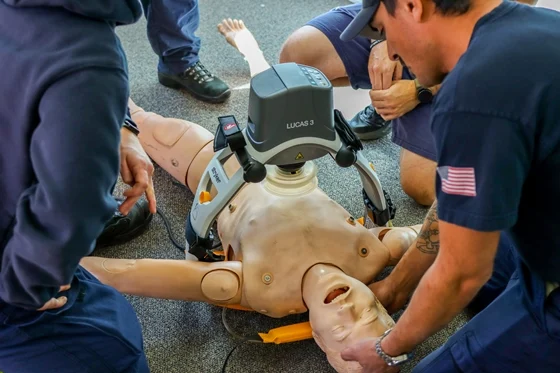
Photo: CAFMA using LUCAS for Training
The Central Arizona Fire and Medical Authority (CAFMA) is proud to announce that crews achieved 13 cardiac arrest “code saves” in 2025, a significant milestone that reflects the skill, coordination, and advanced medical care delivered by CAFMA personnel. So far in 2026, CAFMA crews have already achieved two additional code saves.
In emergency medical services, a “code” refers to a cardiac arrest—when a patient’s heart has stopped beating effectively. A “code save” is defined as a cardiac arrest patient who not only achieves return of spontaneous circulation (ROSC) in the field, but ultimately survives to hospital discharge. Cardiac arrest survival depends on immediate intervention, high-quality CPR, rapid defibrillation, advanced life support, and coordinated post-resuscitation care from first responders through the hospital.
CAFMA believes the increased number of code saves is directly connected to its continued investment in advanced life-saving equipment and highly trained personnel, including the implementation of the LUCAS Chest Compression System on frontline apparatus.
LUCAS devices provide consistent, high-quality mechanical chest compressions during cardiac arrest. Unlike manual CPR, which can be physically exhausting and vary in depth and rate over time, the LUCAS device delivers uninterrupted, precisely measured compressions. This allows paramedics to focus on airway management, medication administration, cardiac monitoring, and identifying reversible causes, all while ensuring optimal blood flow to the brain and vital organs.


“High-performance CPR is critical in cardiac arrest, and the addition of the LUCAS devices has elevated the level of care we are able to provide in the field,” said EMS Chief Doug Niemynski. “When you combine cutting-edge technology with highly trained paramedics and coordinated teamwork, you give patients the best possible chance at survival. Thirteen code saves in one year is something our crews should be very proud of.”
Cardiac arrest survival is also a community effort. Early recognition, immediate 9-1-1 activation, bystander CPR, and public access defibrillation all play critical roles in improving outcomes. That chain of survival continues at Yavapai Regional Medical Center, where hospital teams provide advanced cardiac care, post-resuscitation treatment, and ongoing support that are essential to giving patients the best possible chance at recovery.
CAFMA remains committed to investing in training, equipment, and personnel to provide the highest standard of emergency medical care to the communities it serves.
For more information about CAFMA programs or CPR and AED training opportunities, visit www.cazfire.gov.