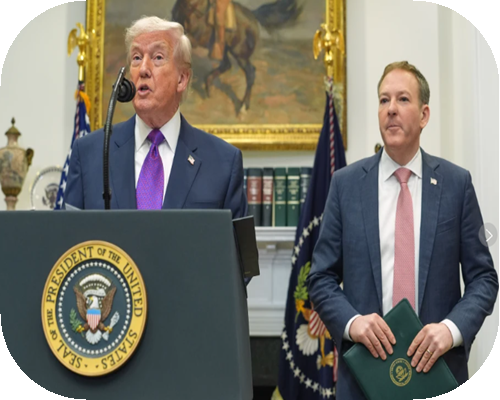
Fact-checking President Donald Trump’s announcement on Thursday regarding the government declaration on climate change and energy. (AP: River Zhang)
In what the White House is calling the “single largest deregulatory action in American history,” the Trump administration has officially repealed the 2009 Greenhouse Gas Endangerment Finding — the legal foundation used for nearly two decades to regulate carbon emissions under the Clean Air Act.
The move dismantles the executive branch’s primary authority to impose federal greenhouse gas standards and reframes the national climate debate around a central constitutional question: Who decides major economic policy — Congress or federal agencies?
“We used a very simple metric,” Environmental Protection Agency Administrator Lee Zeldin said at Thursday’s Oval Office announcement. “If Congress didn’t authorize it, EPA shouldn’t be doing it. Congress never voted for these climate mandates.”
For decades, critics and energy industry leaders have condemned the original finding as an act of overreach by the Obama administration. Standing with Zeldin, President Donald Trump characterized the Obama-era finding as a “disastrous” policy that enabled “unilateral administrative fiats” to bypass elected lawmakers.






The legal basis for regulating greenhouse gases traces back to the U.S. Supreme Court’s 2007 ruling in Massachusetts v. EPA, which held that greenhouse gases qualify as air pollutants under the Clean Air Act. In 2009, then-EPA Administrator Lisa Jackson issued the Endangerment Finding, determining that six greenhouse gases threaten public health and welfare. That finding required the EPA to regulate emissions from motor vehicles and later supported broader regulatory efforts.
But critics have long argued Congress never explicitly authorized such sweeping climate mandates.
The administration argues that the Clean Air Act — first enacted in the 1960s and significantly amended in 1970 — was designed to address localized pollutants such as smog and soot, not global climate change. By rescinding the finding, the EPA says it is exiting the greenhouse gas regulatory space entirely, leaving climate policy to Congress.
“It’s over. Done. Finished,” Zeldin said.
The White House estimates the repeal will save taxpayers more than $1.3 trillion by eliminating federal emissions compliance requirements. Zeldin said removing greenhouse gas standards would reduce the average cost of new vehicles by approximately $2,400.






“The red tape has been cut,” Zeldin added. “Manufacturers will no longer be burdened by measuring, compiling and reporting greenhouse gas emissions… and the forced transition to electric vehicles is eliminated.”
Supporters of the move say EPA regulations distorted energy markets and infrastructure decisions.
“EPA’s Endangerment Finding has been used as the basis for regulations that threaten the reliability of our nation’s electric grid,” said America’s Power President and CEO Michelle Bloodworth, an advocate for the coal industry.
“These regulations, such as President Obama’s Clean Power Plan and President Biden’s Clean Power Plan 2.0, were designed to force the premature retirement of coal power plants across the U.S. and increase our nation’s reliance on electricity sources that are
not as reliable as coal.”
Bloodworth notes that utility companies announced plans to retire more than 55,000 megawatts of coal-fired power generation over the next five years, even as electricity demand is booming.
For Daren Bakst, a senior fellow at the Competitive Enterprise Institute, the EPA’s decision means it can return to its core mission of environmental protection rather than acting as an economic planner.
“Greenhouse gas regulation is a tool that can be used as the basis for some of the most egregious examples of government abuse,” he said.
Environmental organizations and several states have vowed to challenge the repeal in court.


The Sierra Club accused the administration of attempting to “turn back the clock to the 19th century,” and suggested the rollback could expose manufacturers and fossil fuel companies to lawsuits from states and local governments.
The repeal comes as part of a wider shift in federal energy policy. Shortly after returning to office, Trump issued an executive order pausing permitting and leasing for wind energy projects. The Interior Department later suspended leases for five offshore wind projects, citing national security risks.
At a White House event this week, Trump also announced plans for the Pentagon to purchase electricity from coal-fired power plants, arguing the move would strengthen grid reliability. Bloodworth said this decision “is an important reminder of the critical role that coal plays in protecting our national security.”
Coal currently accounts for about 20 percent of U.S. electricity generation, down significantly from its 2007 peak.
With litigation all but certain, the ultimate outcome may again rest with the Supreme Court. At stake is not only the future of federal climate regulation, but the broader question of whether major national policy shifts can be implemented through agency interpretation — or must first pass through Congress.
Trump has made his position clear:
“This radical rule became the legal foundation for the Green New Scam, one of the greatest scams in history.”