

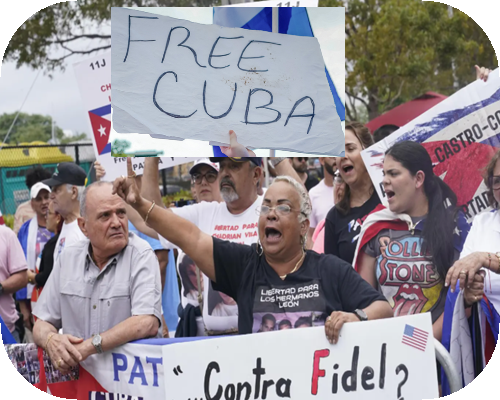
A person holds a “Free Cuba” sign during a rally showing support for Cubans demonstrating against the Cuban communist regime (AP Photo/Marta Lavandier)
Cuban Americans are hopeful that their country’s communist dictator will be the next to fall in the Western Hemisphere after the U.S. military’s successful operation to capture Venezuelan leader Nicolás Maduro on Jan. 3.
Cuba has been ruled by a communist regime since 1959, when Fidel Castro established a one-party system. Now, the Caribbean country is ruled by Miguel Díaz-Canel.
The Epoch Times spoke to more than 50 Cuban Americans of varying ages in Miami, who all praised U.S. President Donald Trump and the U.S. military for the capture of Maduro.
The vast majority expressed hope for similar action against Canel, a small number said patience and restraint are better, and one man described his theory that the Trump administration has a wider scheme at play.





After Maduro’s capture and the seizure of the country’s oil, the U.S. president urged Cuba to strike a deal.
But even if Trump orders a similar operation on the Cuban leader, many expatriates said it would not be enough to rid their home country of a deeply entrenched, brutal regime or to ease the decades of suffering their people have endured.
Murder, unjust imprisonment, torture, and endless unspeakable acts are what have kept the communists in power for so long, they said.
Support for US Action
Oscar Perez, a U.S. Marine veteran who served three tours in Iraq, is now the president of the Cuban American Veterans Association.
He said Canel and the entire Cuban system must be disbanded, at which point he would consider visiting his parents’ home country.






“My dad, I wish he would have seen it,“ he said. ”That was one of his main things in his life, that he wanted to see a free Cuba, and unfortunately, he couldn’t see it. But hopefully, I do.”
He partly credits his enlistment to his Cuban-born father, a staunch anti-communist who escaped political imprisonment twice, served a 12-year sentence, and eventually faced the choice of leaving Cuba or dying. His father trekked through a jungle for 13 days, jumped a fence at Guantanamo Bay, and navigated a Cold War-era minefield to escape his home. The first American his father met was a U.S. Marine.
Perez described how he sees and feels this sentiment of support for the U.S. military among all Cubans and Cuban Americans he interacts with. Perez said the current regime is already teetering, and with the capture of the former Venezuelan leader and the country’s oil, he theorized that the Trump administration could benefit from being patient.
However, Perez praised Trump and the U.S. military operation against Venezuela and said Cubans are ready for similar, direct action to be taken.
“America’s strength, finally,“ Perez said. ”We have been the global leader for many, many years—many, many decades—and we were just not using our political strength the way it should be.”
He predicted that more socialist regimes in the Western Hemisphere will topple in the near future, noting that Cubans and Cuban Americans are thirsty for freedom.
A Survivor’s Account
Lilly, a woman from the Cuban capital, Havana, who declined to share her last name, became a political prisoner in 1961. She spent nearly a decade behind bars.
Every Cuban had a loved one in prison, she recounted.


“It was beautiful before the ‘60s—before the devil came,” Lilly said about Castro, who established the first communist state in the Western Hemisphere and ruled with an iron fist for nearly 50 years.
The same ideals and policies from Castro’s reign are alive and well today, many Cubans told The Epoch Times.
Lilly described horrific conditions her family and tens of thousands of other people have suffered under Cuba’s communist regime. The majority of political prisoners, Lilly said, were charged with a vague communist law she called “against the state,” or contempt of authority. Lilly said she was never charged with a crime during her entire imprisonment.
The decline of Cuba was drastic once Castro took power, she said.
She survived her imprisonment because of a sense of unity among the Cubans being held unjustly. They lived day to day, she said.
“Many of them had husbands or boyfriends,“ Lilly said. ”They were going to trial, and sometimes they were sentenced to death. When they returned from the trials, we got together—we had a little Virgin [Mary]—we got together, and we prayed. We knew that they were going to get killed that night.”
The Cuban men in prison had it worse, she said, forced to listen to the death sentences being carried out by firing squads every night.
Prisoners were punished with beatings, solitary confinement, and forced labor, Lilly said, or simply killed. Often, they were not allowed visitors or were given only one small serving of food per day, such as watery soup or beans.
The expatriate said this treatment is still happening.
Once Lilly was released, she said, there was no more freedom beyond the prison walls.
“It’s time for us to be free,“ she said. ”It’s been 67 years, and nobody has had the guts to do it, but we have a president [Trump] that has the guts to do anything. If everything changed, and there’s still time for me to go back, then I would go back.”
The first place Lilly said she would visit is a cemetery in Havana where her parents are buried.
Young Expats’ Accounts
Two Cuban women, who requested to remain anonymous out of fear of retaliation against their relatives still in Cuba, spoke with The Epoch Times about their search for a better life in the United States.
The two women, aged 26 and 27, were teachers in Cuba before fleeing.
“It was horrible in Cuba. … I had to leave Cuba and stop being a teacher because I didn’t agree with the regime,” one of the women said in Spanish.
The two women did not describe themselves as outspoken activists against the regime, yet their lack of support or commitment to Canel’s regime led to them being treated like political opponents. Both said they and their family members were not allowed to make any decisions for themselves.
“My father—just for having beef in the house, just for that, one meal, nothing more—they put him in jail for several days,” the 27-year-old woman said. In 1963, the socialist regime under Castro made it illegal to slaughter cows or sell beef without government permission.
As of August 2024, the Cuban regime had charged 1,615 ranchers with “conduct associated with the crime of illegal slaughter of beef cattle and trafficking in their meat,” according to the Havana Times.
The 27-year-old woman said that when she was growing up under the communist regime, the government essentially required children to belong to the Union of Young Communists. Both women said that because they did not support or participate in the group, they were treated horribly and viewed as negative examples in the neighborhood and schools.
“I remember how they forced us—all the primary school children—day by day to express support and stand for communism,” one of the women said.
From an early age, it was instilled in them and countless other children that they must support every aspect of the regime, or else there would be consequences, including beatings. The 26-year-old woman told of a particular protest against the regime made up of young Cubans. Many of the participants were beaten and jailed, according to her.
The two women agreed that “everything” would change if the United States were to remove Díaz-Canel, as it did Maduro, and one said she would never be interested in visiting her home country unless a miracle like that occurred.
Another Cuban woman who spoke to The Epoch Times, 30-year-old Betxy García Ruiz, said she would like to see her family in Cuba again one day.
As far as the U.S. military taking action to help the Cuban people, she said she fears for their safety and believes that patience and restraint may be a better path forward.
“When there’s a military attack, one fears for the family,” Ruiz said. “My whole family is there, and … there’s always that fear the population could be hurt.”