


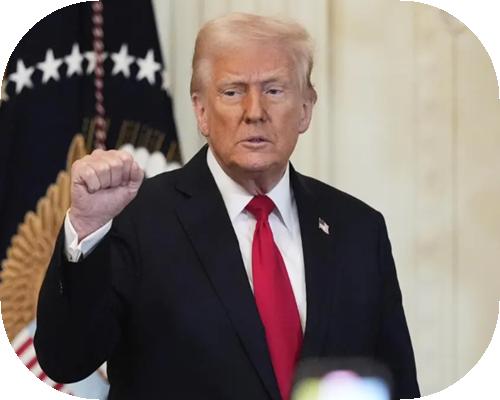
President Donald Trump said April 2nd will be “liberation day” as he’s expected to impose what he calls “reciprocal” taxes that would match the tariffs, sales taxes charged by other nations. AP Photo
President Donald Trump on Dec. 23 said that his tariffs led to a significant expansion of the U.S. economy, after a federal agency released its estimates for the third quarter of 2025.
The U.S. gross domestic product (GDP) grew by 4.3 percent with an increase in consumer spending and exports, according to an estimate released by the Department of Commerce on Dec. 23.
“The TARIFFS are responsible for the GREAT USA Economic Numbers JUST ANNOUNCED … AND THEY WILL ONLY GET BETTER! Also, NO INFLATION & GREAT NATIONAL SECURITY. Pray for the U.S. Supreme Court!!!” the president wrote in a Dec. 23 post on Truth Social.
In a post later on Dec. 23, Trump said that some economists “got it WRONG” in their forecasts about the U.S. economy and that the One Big Beautiful Bill Act, which he signed into law over the summer and which included some new tax provisions, also would help the economy even more.






“Consumer spending is STRONG, Net Exports are WAY UP, Imports and Trade Deficits are WAY DOWN, and there is NO INFLATION! Because of my Tax Bill (THE GREAT BIG BEAUTIFUL BILL) and TARIFFS, INVESTMENT IS SETTING RECORDS,” he also wrote in the post.
GDP increased at a 4.3 percent annualized rate in this past quarter, the fastest pace since the third quarter of 2023, the Commerce Department’s Bureau of Economic Analysis said in its initial third quarter estimate. Economists polled by Reuters had forecast that GDP would rise at a 3.3 percent pace. The economy grew at a 3.8 percent pace in the second quarter.
The Supreme Court is currently hearing a case involving the legality of a range of tariffs that Trump had imposed across most countries in the world, starting in the spring of this year.
Justices heard arguments on the issue in November in lawsuits from companies against the administration that claim that the tariffs were improperly implemented under a 1977 economic law called the International Emergency Economic Powers Act.
Several lower courts overturned the tariffs, prompting the Trump administration to appeal the case to the U.S. high court.






Trump, Treasury Secretary Scott Bessent, and U.S. Trade Representative Jamieson Greer have said that the White House still can impose tariffs through other laws, although the president recently said that it would be more cumbersome and a slower process.
“I’m confident that with other tools we have related to unfair trade practices, we can produce the revenues we need,” Greer said at a Dec. 10 Atlantic Council event, adding, “It is a lot of money. … It’s a big deal.”
Greer said earlier this month that regardless of what the Supreme Court orders, the tariffs are going to remain intact.
Days before, Trump wrote on social media that the current tariff regime under the 1977 law is “far more direct, less cumbersome, and much faster” than what he said were “other methods of charging tariffs.”
Meanwhile, Trump said the tariffs could also be used to provide Americans with a $2,000 dividend payment starting in 2026. Top White House officials, including Bessent and chief economist Kevin Hassett, say that Congress would need to act first.
Meanwhile, Democrats, including House Minority Leader Hakeem Jeffries (D-N.Y.), have criticized Trump’s policies, saying they have made products and services more expensive for Americans.
“Consumer sentiment is at an all-time low,” Jeffries wrote in a post on X on Dec. 19. A day later, he added: “Democrats are focused on driving down the high cost of living. Republicans think the affordability crisis is a hoax.”
Reuters contributed to this report.