
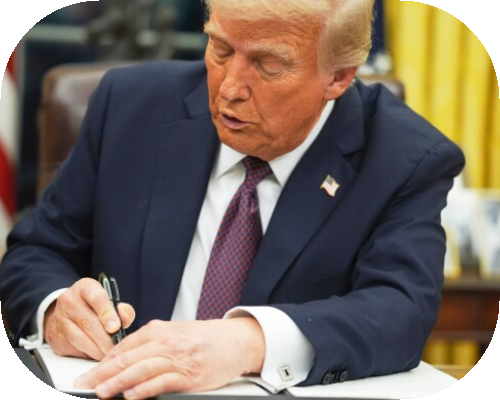
President Donald Trump speaks before signing executive orders in the Oval Office AP News
President Donald Trump said over the weekend that tariff revenues are poised to skyrocket as global buyers exhaust stockpiles of untariffed goods, clearing the way for what he described as record-setting inflows to the U.S. Treasury and a new era of national security and wealth.
In a Nov. 23 post on Truth Social, Trump said foreign importers had stocked up on large quantities of goods ahead of tariff implementation to delay paying duties. That front-loading, he said, created a temporary lag in the full revenue effect of his global tariff regime.
“That heavy inventory purchase is now, however, wearing thin,” Trump wrote, adding that once pre-tariff supplies run out, tariffs will be “paid on everything they apply to, without avoidance, and the amounts payable to the USA will SKYROCKET, over and above the already historic levels of dollars received.”
He said the payments “will be RECORD SETTING” and “put our Nation on a new and unprecedented course,” adding that the power of tariffs will bring national security and wealth “the likes of which has never been seen before.”






Revenue Surge, Pending Supreme Court Ruling
The United States has collected nearly $320 billion in customs and excise taxes so far this year, compared with roughly $170 billion at the same point in 2024, according to the Penn Wharton Budget Model, which is based on Treasury data.
The Tax Policy Center estimates that Trump’s 2025 tariff actions have lifted the average U.S. tariff rate to 17.6 percent, with revenue projected to total about $2.3 trillion from 2026 to 2035. The group estimates that the tariffs will add roughly $256 billion to federal receipts next year and increase the average household’s costs by about $2,200. The group cautions that its figures are “highly uncertain,” as they reflect complex stacking rules and do not include the impact of foreign countermeasures or broader macroeconomic impacts on the U.S. economy.
The future of Trump’s tariffs hangs in the balance at the U.S. Supreme Court, which heard arguments on Nov. 5 on whether the president exceeded his authority by using the International Emergency Economic Powers Act to impose broad, across-the-board duties.
Neal Katyal, a former acting U.S. solicitor general representing business groups challenging the tariffs, told the justices that the duties function as taxes beyond what Congress intended when it passed the statute. Solicitor General D. John Sauer disputed that characterization, arguing that tariffs—even if they generate significant revenue—should be viewed primarily as regulatory tools.





A ruling against the administration could upend the duties altogether. In his Nov. 23 social media post, Trump urged the justices to rule quickly, calling the matter “urgent and time sensitive” and saying he looked forward to continuing his trade agenda “in an uninterrupted manner.”
Trade Representative Jamieson Greer told Fox Business Network earlier this month that he expects a decision before year-end.
Trump’s tariff push has triggered a wave of country-level negotiations.
Earlier this month, the United States reached a trade accord with Switzerland that substantially lowered tariffs and included commitments aimed at boosting U.S. investment and manufacturing.
The administration also rolled back a portion of its agricultural tariffs on Brazil, easing duties imposed under a summer emergency declaration. Brazilian officials welcomed the shift, though several other product-specific levies remain in force.
As negotiations continue and legal challenges advance, Trump said the policy is already reshaping supply chains and speeding domestic reindustrialization.
“We are already the ‘hottest’ Country anywhere in the World,” he wrote, expressing the conviction that tariffs will bring America greater safety and prosperity, while calling those who oppose his trade policies as “serving hostile foreign interests.”
Treasury Secretary Scott Bessent told NBC in a Nov. 23 interview that the tariffs have had a minimal impact on prices, pointing to data showing flat imported-goods inflation, which he said undermines claims that tariffs are leading to higher costs for consumers.


Commerce Secretary Howard Lutnick said on Nov. 24 that the administration wants people to share in the trade policy windfall by issuing $2,000 tariff dividend checks to lower-income Americans.
Jacob Burg and Sam Dorman contributed to this report.