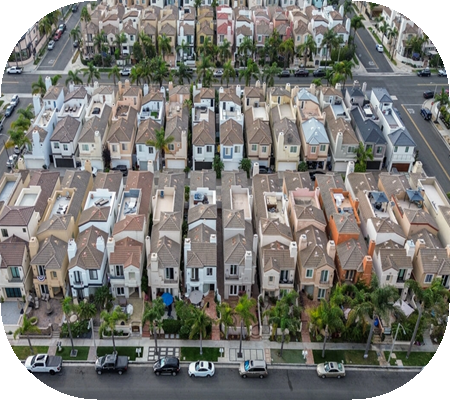
Homes in Huntington Beach, Calif., on July 12, 2024. John Fredricks/The Epoch Times
A decline in mortgage rates improved home affordability conditions in the United States to the best level in three years last month, real estate marketplace Zillow said in a Nov. 18 statement.
The average 30-year mortgage rate fell to 6.25 percent in October, the lowest monthly average in over a year. Meanwhile, home values remained steady from last year. Combined, this led to mortgage payments dipping by 1.8 percent for the month, said Zillow.
In October, the median-earning household had to spend 32.9 percent of its income to pay off a mortgage taken on the typical home after a 20 percent down payment. This is the smallest share required since August 2022, Zillow said.
“Sellers reemerged in October after a sluggish summer, taking advantage of stronger demand and enjoying increased affordability themselves if they purchased another home. New listings picked up most compared to last year in Tampa, Raleigh, Orlando, Columbus, Louisville and Indianapolis,” the statement reads.





Buyers “responded quickly” to the rate relief, with new pending sales up by 5 percent year over year, suggesting resilient demand, Zillow said.
It noted that there was a “rare” surge in sellers listing their properties for sale and accepting offers from buyers, with both up by 5 percent on an annual basis. These metrics were at levels not seen in any October since 2022, the statement said.
While the market remains balanced at the national scale, 19 major housing markets currently favor buyers, according to Zillow.
“Buyers and sellers both got some badly needed relief to perk up what is typically a shoulder season for the housing market. The reaction to lower rates shows that buyers are ready to make offers when affordability improves,” said Kara Ng, Zillow senior economist.
“While fall has been a sneaky good market for buyers and sellers who stuck it out past the busy season, winter is coming, and it may bring rate volatility with it. This warm-up is not guaranteed to last.”


According to data from Freddie Mac, the average rate on a 30-year fixed-rate mortgage was 6.26 percent for the week ending Nov. 20, down from the yearly peak of 7.04 percent reached in January.
Further declines in mortgage rates may require the Federal Reserve to lower its benchmark interest rates significantly.
The Fed cut interest rates for the first time this year in September, followed by another cut in October, bringing rates down to a range of 3.75 percent to 4 percent.
In a Nov. 20 commentary, Lisa Sturtevant, an economist at real estate data company Bright MLS, suggested that uncertainty over the Fed cutting rates in its December meeting—and the release of backlogged economic data that was blocked due to the federal government shutdown—could result in higher mortgage rate volatility through the end of 2025.
“Therefore, as we head into the winter holidays, modestly higher rates and rate volatility means we should expect a traditionally slow seasonal housing market in November and December,” she said.
However, overall home sales in 2025 are likely to be at or slightly above the level seen last year, said the expert.
Homes Selling Quickly
In a Nov. 20 statement, real estate brokerage Redfin said that the median sales price of homes rose by 2.3 percent year over year for the four weeks ending Nov. 16.


However, sales prices are not rising everywhere, it said, adding that in 18 of the 50 most populous U.S. metros, prices have declined.
“Buyers may be able to find a deal,” said Jonathan Buch, a Redfin premier agent in West Palm Beach, Florida. “In today’s slow market, the people who are selling are typically the ones who have to because of a divorce or job relocation.
“Many of those people are willing to sell at a lower price than they could get if they waited for demand to pick up. Still, homes that are fairly priced and move-in ready—especially the ones with pools—are selling quickly, with bidding wars.”
The National Association of Homebuilders said in a Nov. 18 statement that builder sentiment remained “relatively flat” in November despite market headwinds.
Even though there was a decline in single-family housing starts this year, the association forecasts higher starts in 2026, with builders reporting future sales conditions to be in “marginally positive territory,” said Robert Dietz, chief economist with the association.