


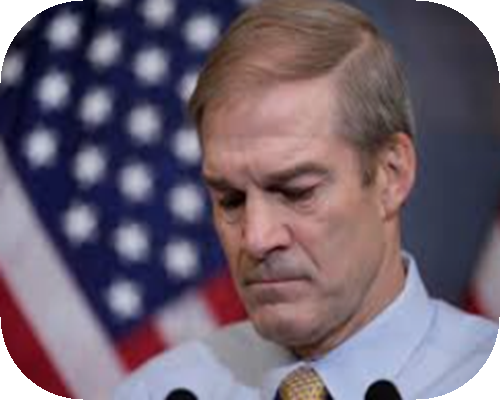
Rep. Jim Jordan during a hearing of the House Select Committee on the Coronavirus in Washington. (AP Photo)
House Republicans told the Supreme Court on Oct. 10 that the Constitution’s guarantee of birthright citizenship didn’t include the children of illegal immigrants.
Their arguments came as part of an amicus brief supporting President Donald Trump’s attempts to appeal lower court decisions stating that he was wrong to exclude the children of illegal immigrants from that guarantee under the 14th Amendment.
The relevant section, known as the citizenship clause,“ of the 14th Amendment reads: ”All persons born or naturalized in the United States, and subject to the jurisdiction thereof, are citizens of the United States and of the State wherein they reside.”
The Oct. 10 amicus brief, which came from 18 Republicans sitting on the House Judiciary Committee, argued that the phrase “subject to the jurisdiction thereof” has historically meant more allegiance than the kind that illegal immigrants might have.




Among the amici were House Judiciary Chairman Jim Jordan (R-Ohio), Rep. Andy Biggs (R-Ariz.), and others.
They urged the Supreme Court to take up Trump’s appeal of two lower court orders blocking his birthright citizenship policy.
The brief noted that the jurisdiction phrasing has not been interpreted as applying to the children of ambassadors or invading soldiers.
“There is a wealth of support for the proposition that the clause applies the same to children of those illegally present in the country because they (like ambassadors and foreign soldiers) do not owe total allegiance to the United States,” the brief reads.
For months, lower courts have been rejecting the Justice Department’s argument that in order to receive birthright citizenship, individuals must owe a certain type of allegiance to the United States.


In a landmark decision from June, the Supreme Court said that nationwide blocks on Trump’s policy were likely illegal, but didn’t rule on the underlying constitutional questions surrounding the 14th Amendment.
After that decision, those cases returned to lower courts where they received updated rulings.
Another case also emerged in New Hampshire, where a judge effectively imposed a nationwide block on Trump’s policy by granting a provisional class that included individuals affected by his order.
That decision and another from Washington have already been appealed to the Supreme Court, which is now expected to provide more guidance as to who can receive birthright citizenship.
For decades, the executive branch has interpreted the citizenship clause as applying to the children of illegal immigrants.
In January, however, Trump disputed this interpretation and excluded children based on certain types of legal statuses—including being unlawfully present—held by their parents.
Since the Supreme Court’s decision, at least two appeals courts have upheld blocks on Trump’s order.
More recently, the U.S. Court of Appeals for the First Circuit indicated Trump’s order was out of step with Supreme Court precedent and federal law.


One of the main points of contention is around the Supreme Court’s 1898 decision in Wong Kim Ark v. United States, which said birthright citizenship applied to a man whose parents were permanently domiciled in the country.
Both the First and Ninth Circuits said recently that the reasoning in this decision lent credence to the idea that the children of illegal immigrants were citizens.
In their amicus brief, House Republicans argued that the Wong Kim Ark case “concluded that foreigners owe the requisite allegiance when the United States permits them to be here permanently.”
House Democrats, meanwhile, have argued against Trump’s order.
“The plain language of the 14th Amendment confers citizenship on all persons born in the United States and subject to its laws,” they said in a June 6 brief.
They added that the Immigration and Nationality Act, passed in 1952, clarified Congress’s intent to confer that type of citizenship.
It states in part that “a person born in the United States, and subject to the jurisdiction thereof” shall be a citizen at birth.
The First Circuit similarly said this month that even if the Trump administration was interpreting Wong Kim Ark correctly, Trump’s order likely excluded people who should receive citizenship under the Immigration and Nationality Act.
Part of Trump’s appeal to the Supreme Court has asked the justices to address the meaning of this law.
The administration has argued that both Congress’s law and the Constitution should have the same meaning.
“The Citizenship Clause does not grant birthright citizenship to children of aliens who are temporarily or unlawfully present in the United States,” U.S. Solicitor General D. John Sauer said.
“[The Immigration and Nationality Act] therefore does not extend citizenship to those persons either.”