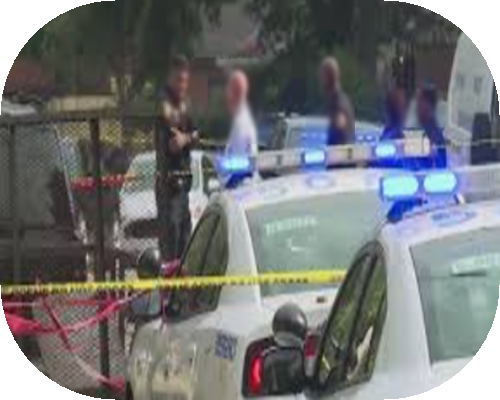
Police investigate the scene of a carjacking suspected to be connected to a series of shootings in Memphis on Sept. 7, 2025
Memphis is a city with a proud heritage—birthplace of the blues and rock and roll, headquarters of FedEx and St. Jude Children’s Research Hospital—but it also claims the dubious title of one of the most dangerous U.S. cities.
As President Donald Trump moves to send the National Guard and federal agents into Memphis to help quell the violence, state and city officials in Tennessee are sharply divided over the role the federal government should play in municipal law enforcement.
The city ranked first among all major U.S. cities in 2024 in both per capita violent crime and property crime, according to an August analysis of FBI data on the 30 most populous U.S. cities compiled by security.org, a home security marketing and research group.
Last year, Memphis had a violent crime rate that was about six times greater than the national average at 2,500 violent crimes per 100,000 residents and a property crime rate about three times greater than the national average, the organization reported.




In addition to sending in the National Guard, Trump’s Sept. 15 memorandum titled Restoring Law and Order in Memphis, will create a multiagency task force that includes the Pentagon, the FBI, the Department of Homeland Security, the attorney general; the Department of Health and Human Services, and the Bureau of Alcohol, Tobacco, Firearms, and Explosives (ATF).
The role of the task force will be to enact “hypervigilant policing, aggressive prosecution, complex investigations, financial enforcement, and large-scale saturation of besieged neighborhoods with law enforcement personnel,” the memorandum states, pledging that federal agents will collaborate with state and local officials in Tennessee.
“The city of Memphis, Tennessee, is suffering from tremendous levels of violent crime that have overwhelmed its local government’s ability to respond effectively,” it reads. “This situation has become dire in one of our Nation’s most historic cities.”
Many state officials welcomed the move.
Tennessee Gov. Bill Lee wrote on X, “Our goal is to accelerate the positive momentum of Operation Viper—an ongoing FBI mission in Memphis with a dedicated task force of federal, state, and local law enforcement that has already arrested hundreds of the most violent offenders.”






The operation includes the deployment of 100 highway patrol officers into Memphis to help local police.
“Between the National Guard, increased highway patrol, increased FBI, and increased support to local police of our community, I think this is a good move while we stabilize some of the issues that have been plaguing our community for the last couple years,” state Rep. Mark White, who represents Shelby County—in which Memphis is located—told The Epoch Times.
“The national guard will look more like administrative help to free up our law enforcement officers, such as our Shelby County sheriffs and our Memphis police, so they can be on the streets and do their job.”
Coming Down From a Murder Spike
Memphis police reported a spike in violent crime starting in 2020 and peaking in 2023, although the city’s murder rate began accelerating in 2018. White said a shortage of police officers has contributed to the problem, but school closures during the COVID-19 pandemic made it worse.
“With the pandemic, many of the children did not return to school,” he said. “We had too much chronic absenteeism, and that put a lot of young people on the streets, and they got involved in criminal activities.”
However, Memphis city officials say they have been making progress in reducing violence and question whether using military troops is the solution.
In response to Trump’s memorandum, J. Ford Canale, chairman of the Memphis City Council, said in a video posted on social media on Sept. 15, “Today, we face a decision that weighs heavily on our city and our people.”


“For many Memphians, the very mention of the National Guard recalls painful memories from 1968,” Canale said in a statement emailed to The Epoch Times, calling the deployment of the National Guard “at best, a short-term measure.”
The National Guard was sent to Memphis in 1968 to quell unrest following the assassination of civil rights leader Martin Luther King Jr. City officials now say the National Guard is a poor choice when the problem is not riots but everyday policing.
“They don’t really have crime-fighting capacity; they know nothing about and are not trained regarding community policing, so how is this beneficial to the people of Memphis?” City Councilman JB Smiley told The Epoch Times. “If the goal is to reduce crime, what happens when they leave after two weeks or three weeks?”
On Sept. 9, Memphis police reported “historic crime reductions,” with decreases across all major categories of crime during the first eight months of 2025.
Overall crime, robbery, burglary, and larceny were at 25-year lows, according to the department, with murder at a six-year low, aggravated assault at a five-year low, and sexual assault at a 20-year low.
City Officials Say Long-Term Efforts Needed
City officials credit support from the FBI and the ATF as contributing to this success but say a number of longer-term local efforts have been the key drivers, including “crisis intervention teams,” a “community outreach program,” and a “violence intervention program,” which is a combination of social work and policing originally developed under the Obama administration.
“There’s a certain number of people who are doing the vast majority of the murders and violent crime, and you target those people to see how you can stop them from committing the next violent crime or the next murder,” City Councilman Jeff Warren told The Epoch Times.
At the same time, the program works to steer them away from a criminal life, he said.
“If you look across the country, there’s been a drop in violent crime in most of the major cities that have used this type of program and begun to try to stop these young people from killing each other. Having the National Guard here won’t hurt anything, but I just don’t see how it’s going to be a long-term solution for us,” Warren said.
Some city officials oppose efforts to federalize local law enforcement, which is traditionally the jurisdiction of cities and states.
“If you truly want to bridge the gap between community and police, it has to be done in a way in which the people know the folks there patrolling their neighborhoods,” Smiley said.
A Council on Criminal Justice report in July found that although Memphis has made progress in fighting crime, according to numbers between 2018 and June 2025, in a study of 38 major cities, it lags behind other cities in reducing homicides.
“The homicide rate in Memphis is among the highest in the study sample and is dropping slower than it is in other large cities,” the report reads. “But Memphis is outpacing other cities in recent declines in reported carjacking and motor vehicle theft.”
Although carjacking and robbery incidents in Memphis were 45 percent and 23 percent lower, respectively, in the first half of 2025 compared with the first half of 2019, the number of murders remained 58 percent higher for this timeframe, according to the report.