

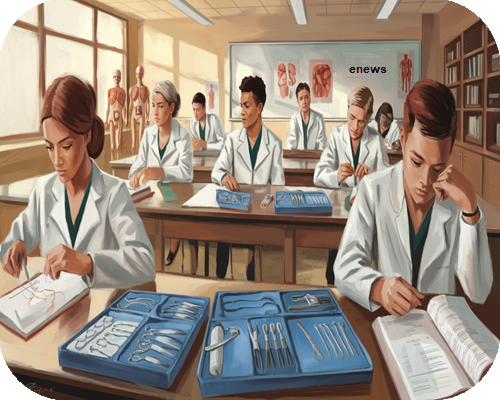
Health science offers a solid foundation for high school students aiming to become doctors or pursue careers in allied health fields. Among the practical skills introduced, suturing stands out as one of the most valuable for future healthcare professionals.
Whether students dream of becoming surgeons or plan to work in emergency care or nursing, suturing is a fundamental part of their future.
But when it comes to teaching suturing, traditional methods like lectures and textbooks often fall short. Without hands-on practice, students miss out on the real-world precision and feel that medical procedures require.
That’s where suture kits come in, they bring lessons to life and give students a chance to apply what they learn.
If you’re a health science teacher, here are five key reasons to include suture kits in your classroom.





1. Encourages Active, Hands-On Learning
Today’s students need engaging, hands-on experiences that help them truly retain information, and suture kits offer exactly that.
Instead of just reading about wound care, students get to feel the tension of the surgical thread, adjust pressure, and understand which techniques work best. This hands-on practice builds deeper understanding than lectures alone.
Research shows that active learning like this improves retention. Students who practice with suture kits remember the skills longer because they’ve built both mental and muscle memory through direct experience.
2. Builds Technical and Motor Skills Early
Beyond retention benefits, healthcare professions demand exceptional hand-eye coordination and fine motor control.
Suture practice kits give students a head start on developing these crucial abilities, allowing them to strengthen the same muscle groups and neural pathways they’ll use throughout their medical careers.


Early exposure to these skills also builds confidence before students enter formal clinical training.
When they eventually work with real patients, they’ll already understand the basic mechanics of suturing. This foundation reduces anxiety and allows them to focus on more complex aspects of patient care.
Some of the key motor skills developed through suturing practice are:
- Bilateral hand coordination
- Finger dexterity and precision
- Spatial awareness and depth perception
- Steady hand control under pressure
These physical skills lay the groundwork for success in any clinical setting where precision and control are critical.
3. Supports Career Exploration and Readiness
Many enter health programs with big ideas about medicine, but hands-on suturing quickly shows them what the work actually feels like.
For some, the sight of simulated blood, the unpleasant smell of antiseptics, or the appearance of a mock wound can be unexpectedly unsettling.
This experience helps students discover whether they enjoy precise, detail-oriented tasks or prefer roles with more patient interaction.
It’s also a smart way to guide career choices early on. Students who enjoy suturing may lean toward surgery or emergency care, while others may shift to nursing or therapy.


Plus, hands-on experience strengthens college applications and shows true interest in healthcare.
4. Promotes Problem-Solving and Critical Thinking
Career preparation aside, suturing isn’t just about following steps in a manual. Students must constantly assess their work, adjust their technique, and solve problems in real-time.
When a knot doesn’t hold properly, they need to understand why and make corrections immediately. This process encourages deeper thinking about anatomy and physiology.
Students begin to understand how tissue layers affect suture placement and why certain materials work better for different wound types. Rather than just memorizing facts, they’re applying knowledge to solve practical problems.
Furthermore, peer collaboration naturally emerges during suturing practice. Students help each other troubleshoot difficulties, share techniques, and provide feedback. These interactions build communication skills essential for healthcare teamwork.
5. Safe, Scalable, and Classroom-Friendly
Despite these complex benefits, modern suture kits designed for educational use prioritize safety and practicality. Synthetic practice pads eliminate biological hazards while providing realistic texture and resistance. Meanwhile, blunt-tip needles reduce injury risks while still teaching proper technique.
These kits are surprisingly affordable and require minimal setup. A single set of materials can serve multiple students over several semesters.
Storage requirements are also minimal, making them practical even for schools with limited space.
Most importantly, proper supervision ensures safe implementation. Teachers can easily monitor student progress and provide immediate feedback.
The controlled classroom environment allows for systematic skill development without the pressures of clinical settings.
Final Thoughts
Suture kits represent a powerful tool for transforming health science education from passive to active learning. They build essential skills, support career exploration, and make abstract concepts tangible.
For educators seeking to prepare students for healthcare careers while making science more engaging, suture kits offer an accessible, effective solution that bridges the gap between classroom theory and professional practice.