

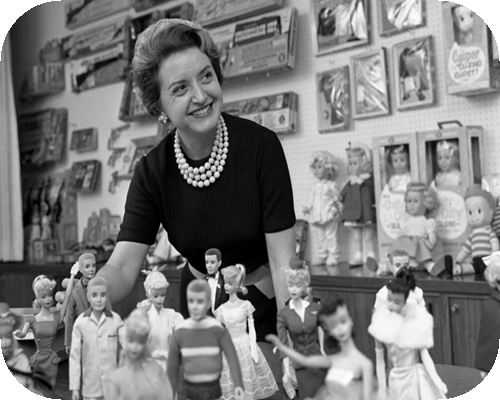
Barbie creator Ruth Handler with an assortment of Barbie and Mattel products in 1961. (CREDIT: Wikipedia)
Sometimes, it’s the popular girls who get picked on the most. Just ask a certain blonde. Because she’s heard it all over the years.
“She’s unrealistically beautiful!”
“She feeds stereotypes about gender roles!”
“She promotes body shaming!”





And yet she remains as popular as ever. Although she’s now 67, she doesn’t look a day over 19. Oh, she’s also among the best-selling toys of all time.
Yes, it’s Barbie, Mattel’s beloved doll with a career stretching back to the Eisenhower Administration. And even though she’s old enough to qualify for Social Security, she’s still a superstar with American girls — on the store shelves and at the box office. (At $1.4 billion, the 2023 Barbie movie was Warner Brothers’ highest-grossing release of all time.)
Feminists have bashed the plastic plaything for decades as a bad role model for girls. Yet the story of how she became a childhood toybox staple is a testimony to one woman’s real-life vision and persistence.
Ruth Handler was something of a rarity for the 1950s. She was both a mother and a successful businesswoman. She had joined her husband, Elliot, and Harold “Matt” Mattson in 1945 to create a company in a California garage. It made picture frames and, with scraps of leftover plastic, furniture for dollhouses. They combined the men’s first names and christened the new business Mattel. (“We couldn’t find a way to work in Ruth’s name,” Mattson later recalled.) They weren’t getting rich, but everyone was eating.
They had a hit in 1947 when a miniature ukulele, the “Uke-A-Doodle,” put Mattel on the toy-making map. Poor health forced Mattson to bow out of the business the following year.




As the company grew, so did the Handler’s family: a daughter, Barbara, and a son, Kenneth. While watching her little girl play one day, Ruth noticed something interesting.
Dolls at that time were mostly babies and toddlers. But Barbara and her friends were captivated by flat, cutout paper dolls showing adult women. They could be adorned with a variety of paper dresses, and girls could imagine them at home with their family, working in a business office, or even leading the glamorous life of a movie star.
That got Ruth’s imagination going. What if there were a plastic doll depicting a young woman for girls to play with? She kept churning it over and over in her mind, imagining what one would look like.
Elliot and Mattel’s board of directors were, to put it mildly, unreceptive to the idea. But Ruth refused to give up.
Then, on a 1956 trip to Europe, inspiration met reality.
While shopping one day in Lucerne, Switzerland (or maybe it was Geneva or Vienna; she remembered it differently over the years), Ruth stumbled upon something remarkable. It was a German doll of an adult woman named Bild Lilli. Bild was a popular German newspaper, and Lilli was a cartoon character who appeared in it. An array of clothing could be put together to outfit her for a variety of situations.
Though originally created as a novelty for adults, European girls claimed Lilli as their own, vindicating Ruth’s idea. She bought three of the dolls; one was a gift for little Barbara; the other two were taken to Mattel headquarters.
Inventor-designer Jack Ryan took it from there, reimagining the doll until it became the figure we know today. Both blonde and brunette, she wore a zebra-striped bathing suit, sported a ponytail, and was billed as a “teen model.” (She even got a brief bio with Willows, Wisc., as her hometown.) Ruth named the doll Barbie after the daughter.


She won over Mattel’s board, which reversed course and decided to go big on the new doll.
When Barbie debuted on March 9, 1959, at the American International Toy Fair in New York, she was an instant hit. True, some parents objected to the doll’s, um, let us say ample bosoms. But that didn’t dampen sales. Even its $3 price tag (about $33.50 today) didn’t prevent folks from snatching it up.
In all, 350,000 Barbies were initially sold, blowing away original estimates. Business was so brisk that Mattel couldn’t keep up with demand for the first three years. Things picked up even more in 1961 when Barbie acquired boyfriend Ken, named for Ruth’s son Kenneth. With that, both children were ensconced in the world of toy legends.
By 2006, it was estimated that more than one billion dolls have been sold in some 150 countries. Mattel now says that more than one doll is sold every second somewhere in the world.
Barbie not only made Ruth Handler rich. The doll also gave her one of the biggest “I told you so’s” in history.